
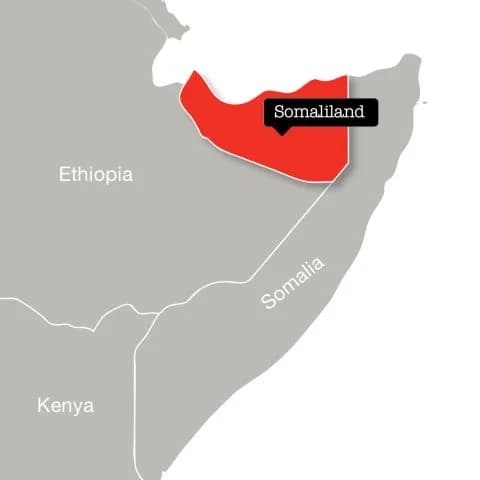
Rwanda has joined the African Union (AU) and the East African Community (EAC) in reaffirming its support for Somalia’s sovereignty and territorial integrity amid renewed international debate over Somaliland’s status. In a statement released on Sunday, December 28, the Ministry of Foreign Affairs and International Cooperation said Rwanda “fully aligns with the statements issued by the African Union and the East African Community in support of Somalia, and encourages the pursuit of a path forward based on shared peace and prosperity, in accordance with international law." Rwanda’s position fol
Rwanda has joined the African Union (AU) and the East African Community (EAC) in reaffirming its support for Somalia’s sovereignty and territorial integrity amid renewed international debate over Somaliland’s status. In a statement released on Sunday, December 28, the Ministry of Foreign Affairs and International Cooperation said Rwanda “fully aligns with the statements issued by the African Union and the East African Community in support of Somalia, and encourages the pursuit of a path forward based on shared peace and prosperity, in accordance with international law." Rwanda’s position follows strong remarks by the Chairperson of the African Union Commission, Mahmoud Ali Youssouf, who rejected any move to recognise Somaliland as an independent state. He reiterated the AU’s firm commitment to Somalia’s unity and sovereignty. Youssouf recalled the AU’s long-standing policy, rooted in its Constitutive Act, which upholds respect for borders inherited at independence, a principle adopted by the Organisation of African Unity in 1964. The AU Commission has dismissed any initiative seeking to recognise Somaliland, stressing that the region remains an integral part of the Federal Republic of Somalia. It warned that actions undermining Somalia’s unity and territorial integrity could create a dangerous precedent, threatening peace and stability across the continent. The Commission also reaffirmed its support for Somalia’s federal authorities as they work to strengthen state institutions, consolidate peace, and promote inclusive governance. The renewed diplomatic attention follows an announcement by Israel on Friday describing Somaliland as an “independent and sovereign state,” making it the first country to publicly adopt such a position. Somalia’s federal government strongly condemned the statement, calling it a direct violation of its sovereignty and a risk to regional stability. Somaliland declared independence from Somalia in May 1991 after the collapse of the central government and years of civil conflict. Although it has established its own administration, security forces, and currency, it has not received formal international recognition. Several international partners have since distanced themselves from Israel’s position. The United States reaffirmed its recognition of Somalia’s territorial integrity, explicitly including Somaliland. The European Union also criticised the move, warning that it could undermine peace and security, and urged dialogue to resolve long-standing differences between Mogadishu and Hargeisa. What is Somaliland? Somaliland is a self-declared republic in the Horn of Africa, located in the northwestern part of internationally recognised Somalia. It borders Djibouti to the northwest, Ethiopia to the south and west, the Gulf of Aden to the north, and Somalia’s Puntland region to the east. The region proclaimed independence in 1991 following the collapse of Somalia’s central government. Despite lacking international recognition, Somaliland has maintained a separate political and administrative system for more than three decades. Historically, Somaliland was a British protectorate. It gained independence in June 1960 and voluntarily united days later with the former Italian Somaliland to form the Somali Republic. Over time, political exclusion, economic neglect, and violent repression, particularly during the 1980s, fuelled opposition in the north. After the fall of Somalia’s military regime, regional leaders withdrew from the union and reasserted sovereignty within the borders of the former British territory. Somaliland operates a relatively stable political system compared to much of the region. It has its own constitution, elected leadership, parliament, judiciary, and security forces. Several competitive elections have been held, including peaceful transfers of power. Its governance system combines modern democratic institutions with traditional clan structures, including councils of elders that play a role in mediation and consensus-building. The economy depends largely on livestock exports to Gulf countries through the port of Berbera, as well as remittances from the diaspora. Recent expansion of Berbera Port has strengthened its role as a regional trade gateway, particularly for Ethiopia. However, the absence of international recognition continues to limit access to foreign investment, international finance, and development assistance. Culturally, Somaliland shares language, religion, and traditions with other Somali regions. Somali is the main language, and Islam is the dominant faith. Clan structures remain central to social and political life. The capital, Hargeisa, serves as the region’s cultural and economic hub. What international law says International law does not provide a single, automatic process for the creation or recognition of new states. Instead, it relies on established principles, customary practice, and political judgment. The 1933 Montevideo Convention outlines four key criteria for statehood: a permanent population, a defined territory, an effective government, and the capacity to conduct foreign relations. An entity meeting these conditions may qualify as a state in legal terms, even without formal recognition, although recognition is critical in practice. Ultimately, recognition remains a political decision by existing states. While international law supports independence in cases such as decolonisation or severe rights violations, new states usually emerge through negotiated settlements or referendums. Admission to the United Nations significantly strengthens recognition, but geopolitical interests often determine whether statehood claims gain broad international acceptance.

Comments
No comments yet. Be the first to share a thought.