
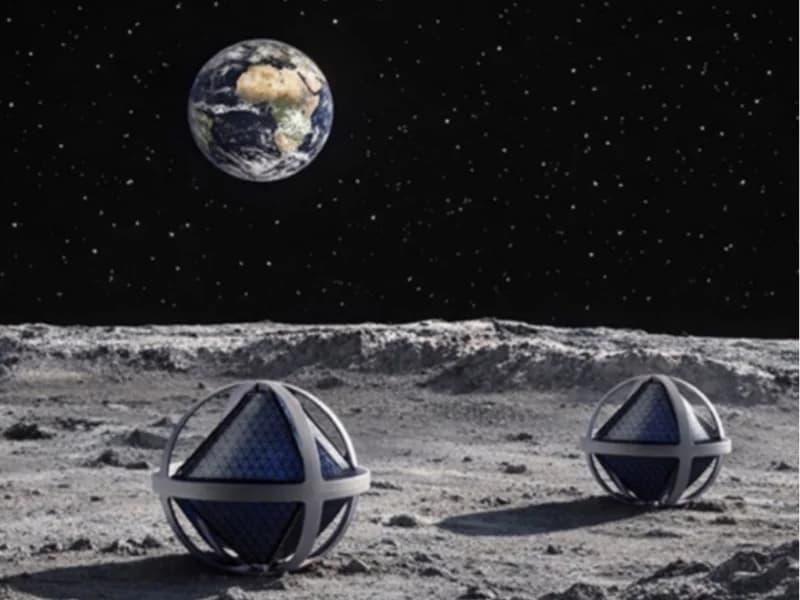
South Africa is preparing for a historic step in space exploration through the Africa2Moon project, which aims to send South African-designed B.A.L.L.S. to the Moon aboard China’s Chang’e-8 mission, expected in 2029. The initiative could mark a major milestone for South African science and technology and strengthen Africa’s participation in lunar exploration. B.A.L.L.S. stands for Bounced African Low Lunar Spheres. The specially designed metal spheres contain low-frequency radio antennas that will help scientists detect signals from deep space, particularly frequencies below 10 MHz. These sig
South Africa is preparing for a historic step in space exploration through the Africa2Moon project, which aims to send South African-designed B.A.L.L.S. to the Moon aboard China’s Chang’e-8 mission, expected in 2029. The initiative could mark a major milestone for South African science and technology and strengthen Africa’s participation in lunar exploration. B.A.L.L.S. stands for Bounced African Low Lunar Spheres. The specially designed metal spheres contain low-frequency radio antennas that will help scientists detect signals from deep space, particularly frequencies below 10 MHz. These signals are difficult to observe from Earth because they can be blocked or distorted by the planet’s atmosphere. The Moon offers a potentially much better environment for this type of research because it does not have a substantial atmosphere. By placing the antennas on the lunar surface, scientists hope to study radio signals that cannot be effectively detected from Earth and gain new insights into the universe. The long-term vision of the Africa2Moon project is even more ambitious. Researchers hope to eventually deploy 55 antennas on the lunar surface, with each antenna representing an African nation. Working together, the antennas could form a unique low-frequency radio telescope array capable of investigating some of the universe’s oldest and least-understood signals. The project is led by the Foundation for Space Development Africa, with support from the South African Radio Astronomy Observatory (SARAO), South African National Space Agency (SANSA), Stellenbosch University, Rhodes University, and the University of KwaZulu-Natal (UKZN). SARAO engineers are developing the metal spheres, while UKZN researchers are working on the antenna systems. Stellenbosch University’s Electronic Systems Laboratory is contributing to the electronics that will allow the antennas to communicate and transmit scientific data once they are deployed on the Moon. Before the mission, a demonstration model will undergo extensive testing in China to determine whether the technology can withstand the extreme conditions of space and operate successfully on the lunar surface. The Africa2Moon project also highlights South Africa’s growing experience in space technology. In 1999, the country launched SUNSAT, its first satellite. More than two decades later, South African researchers are developing technology designed to operate on the Moon. If successful, Africa2Moon could become a significant milestone not only for South Africa but for the wider African continent, demonstrating the ability of African scientists, engineers and students to contribute to advanced space exploration and scientific research.



Comments
No comments yet. Be the first to share a thought.