
A U.S. Navy F/A-18 Super Hornet fighter jet has been lost at sea after it was accidentally pulled overboard from the USS Harry S. Truman while being towed aboard the aircraft carrier, the Navy confirmed in a statement issued Monday. The incident occurred amid reports that the Truman had executed a hard evasive turn in response to an incoming missile and drone attack launched by Yemen's Houthi rebels. The Iranian-backed group has claimed responsibility for the attempted strike, which targeted the carrier currently operating in the Red Sea as part of ongoing U.S. military operations in the regi
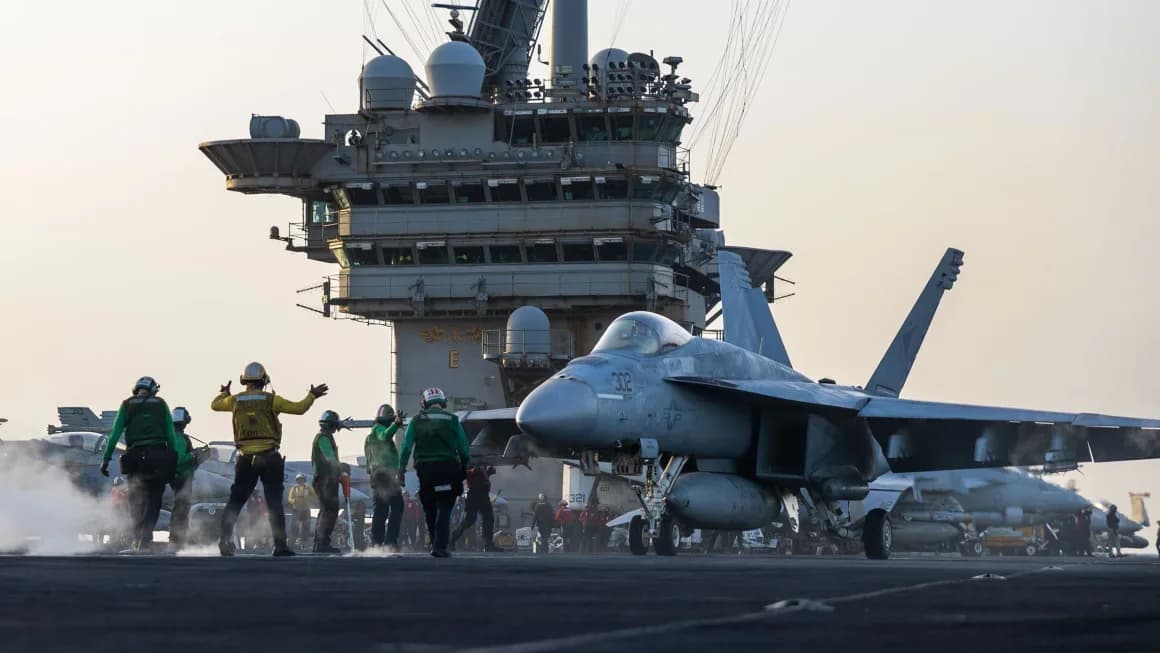
A U.S. Navy F/A-18 Super Hornet fighter jet has been lost at sea after it was accidentally pulled overboard from the USS Harry S. Truman while being towed aboard the aircraft carrier, the Navy confirmed in a statement issued Monday. The incident occurred amid reports that the Truman had executed a hard evasive turn in response to an incoming missile and drone attack launched by Yemen's Houthi rebels. The Iranian-backed group has claimed responsibility for the attempted strike, which targeted the carrier currently operating in the Red Sea as part of ongoing U.S. military operations in the region. According to the Navy, “The F/A-18E was actively under tow in the hangar bay when the move crew lost control of the aircraft. The aircraft and tow tractor were lost overboard. Sailors towing the aircraft took immediate action to move clear of the aircraft before it fell overboard.” One sailor sustained a minor injury, and all other personnel aboard the vessel have been accounted for. A U.S. official told CNN that early reports from the scene suggested the carrier's sharp maneuver contributed to the fighter jet falling overboard. A second official confirmed the aircraft had sunk. The cost of an individual F/A-18 fighter jet exceeds $60 million. The Harry S. Truman, a Nimitz-class aircraft carrier, is among the largest warships in the world. Despite its size—measuring nearly 1,100 feet in length and displacing almost 100,000 tons—it is capable of executing agile high-speed maneuvers due to its twin nuclear reactors and four propeller shafts. The vessel can reach speeds over 34 miles per hour. Although specific details of the ship’s maneuver to avoid Houthi fire have not been disclosed, similar evasive tactics employed by U.S. carriers are well documented. Carl Schuster, a former U.S. Navy captain, explained to CNN that such ships typically perform a series of rapid “zig-zag” turns during missile defense operations. “You typically do a series of alternating 30- to 40-degree turns. Each takes about 30 seconds each way, but the turn starts sharply. It is like riding in a zig-zagging car,” Schuster said. “The ship leans about 10 to 15 degrees into the turn, but it displaces the ship about 100 to 200 yards from any likely aim point,” he added, noting this only works effectively when the ship is traveling at maximum speed. Despite the loss of the aircraft, the Navy stressed that the Truman Carrier Strike Group and its embarked air wing "remain fully mission capable." The Truman has been under increasing threat in recent months. In February, it collided with a merchant vessel near Egypt, though no injuries were reported. Additionally, in December, another F/A-18 from the carrier was mistakenly shot down by the guided missile cruiser USS Gettysburg during operations in the Red Sea. Both pilots ejected and were recovered safely. Other U.S. Navy ships in the area have also faced close calls. Earlier this year, a U.S. destroyer deployed in the Red Sea narrowly avoided a missile strike when a Houthi-fired cruise missile approached within a mile, prompting the use of the Phalanx Close-In Weapon System—America’s last-resort ship defense system. The attacks stem from the Houthis’ broader campaign to disrupt Red Sea shipping, which escalated in response to Israel’s invasion of Gaza in October 2023. The group began targeting commercial vessels en route to Israel, prompting U.S. intervention. The U.S. has since launched intensified airstrikes against Houthi positions in Yemen. These operations have drawn condemnation and threats from the Houthis, who say they will continue to target American assets unless the blockade on Gaza is lifted. “Yemen will not back down from continuing its support operations for the Palestinian people until the Israeli aggression on Gaza stops and the siege is lifted,” the Houthi-controlled armed forces said in a recent statement. In response to the U.S. airstrikes, they warned that American "aggression" would "only lead to further targeting, engagement, and confrontation." On Monday, the Houthis also alleged that a U.S. airstrike had struck a detention facility housing African migrants in Yemen’s Saada region, reportedly killing dozens. The U.S. military has not commented on that specific claim.



Comments
No comments yet. Be the first to share a thought.