
Australia’s fertility rate has dropped to near-historic lows, driven by deepening “baby recessions” in its largest cities and ongoing cost-of-living pressures that have discouraged young families from having children. According to preliminary analysis by KPMG of Australian Bureau of Statistics (ABS) population data, the national fertility rate fell to 1.51 children per woman in 2024. This figure is statistically similar to the 1.5 recorded in 2023, but significantly below the 1.8 fertility rate observed a decade ago. According to The Guardian, the decline was most pronounced in the urban cen
Australia’s fertility rate has dropped to near-historic lows, driven by deepening “baby recessions” in its largest cities and ongoing cost-of-living pressures that have discouraged young families from having children. According to preliminary analysis by KPMG of Australian Bureau of Statistics (ABS) population data, the national fertility rate fell to 1.51 children per woman in 2024. This figure is statistically similar to the 1.5 recorded in 2023, but significantly below the 1.8 fertility rate observed a decade ago. According to The Guardian, the decline was most pronounced in the urban centres of Sydney, Melbourne, and Brisbane, where birthrates continued to fall from 2023 to 2024. Melbourne recorded the lowest fertility rate among the major cities at 1.4 children per woman, a sharp drop from 1.71 in 2014. While these declines were partially offset by modest increases in regional areas and in Perth, the overall national trend reflects growing hesitancy among young Australians to start or expand families amid economic uncertainty. Amanda Davies, professor of demography at the University of Western Australia, said rising living expenses, especially housing affordability, were significant barriers for many families. “Not much has changed for people who are looking at having a family or thinking about extending their family; they are really struggling,” Davies said. “There’s a feeling they need to have secure housing before starting a family, and that extreme housing crisis being faced in all parts of Australia is linked to that declining fertility rate.” The trend has also deepened the demographic divide between city centres and outer suburbs or regional towns. Australians living in outer-suburban or regional areas are now more likely to have more children than those in inner-city neighbourhoods, the analysis found. Economist Ashton De Silva, a professor at RMIT University, said rising costs were continuing to push families out of city centres and toward the urban fringes. “Children are becoming more and more expensive,” De Silva said. “Unless something drastic changes, I would probably continue to expect to see that families are going to be located on the urban fringes.” Urban economist Terry Rawnsley of KPMG noted that while birthrates in capital cities have fallen, some regional areas have seen a rise in childbirths in absolute terms over the past decade. “People have shifted out of Sydney and Melbourne; sparked by Covid, followed up by the ability to work remotely, and then housing cost refugees, to places like Newcastle and Geelong,” Rawnsley said.
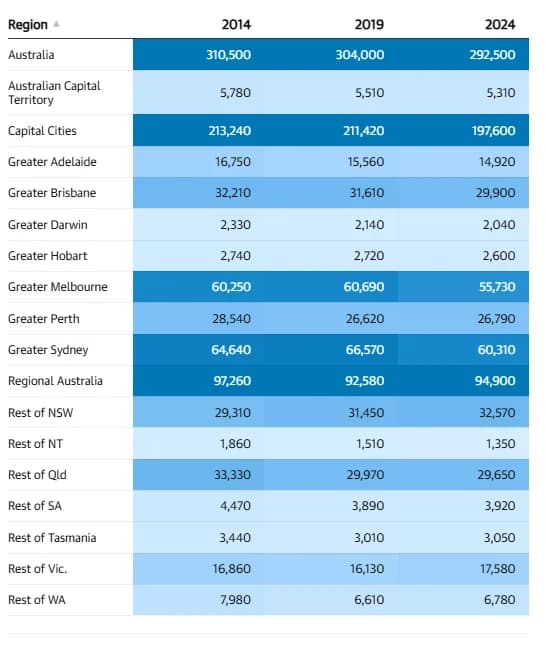
Births year per year Source: The Guardian
With the fertility rate well below the replacement level of 2.1 children per woman, continued decline would lead to a shrinking locally born population in the long term. That trend could increase Australia’s reliance on interstate and international migration to maintain labour force levels in major urban centres, Rawnsley warned. While regional Australia continues to see a modest increase in the number of children born each year, the nation’s broader demographic outlook is increasingly shaped by economic factors that are dissuading family growth in key metropolitan areas.



Comments
No comments yet. Be the first to share a thought.