
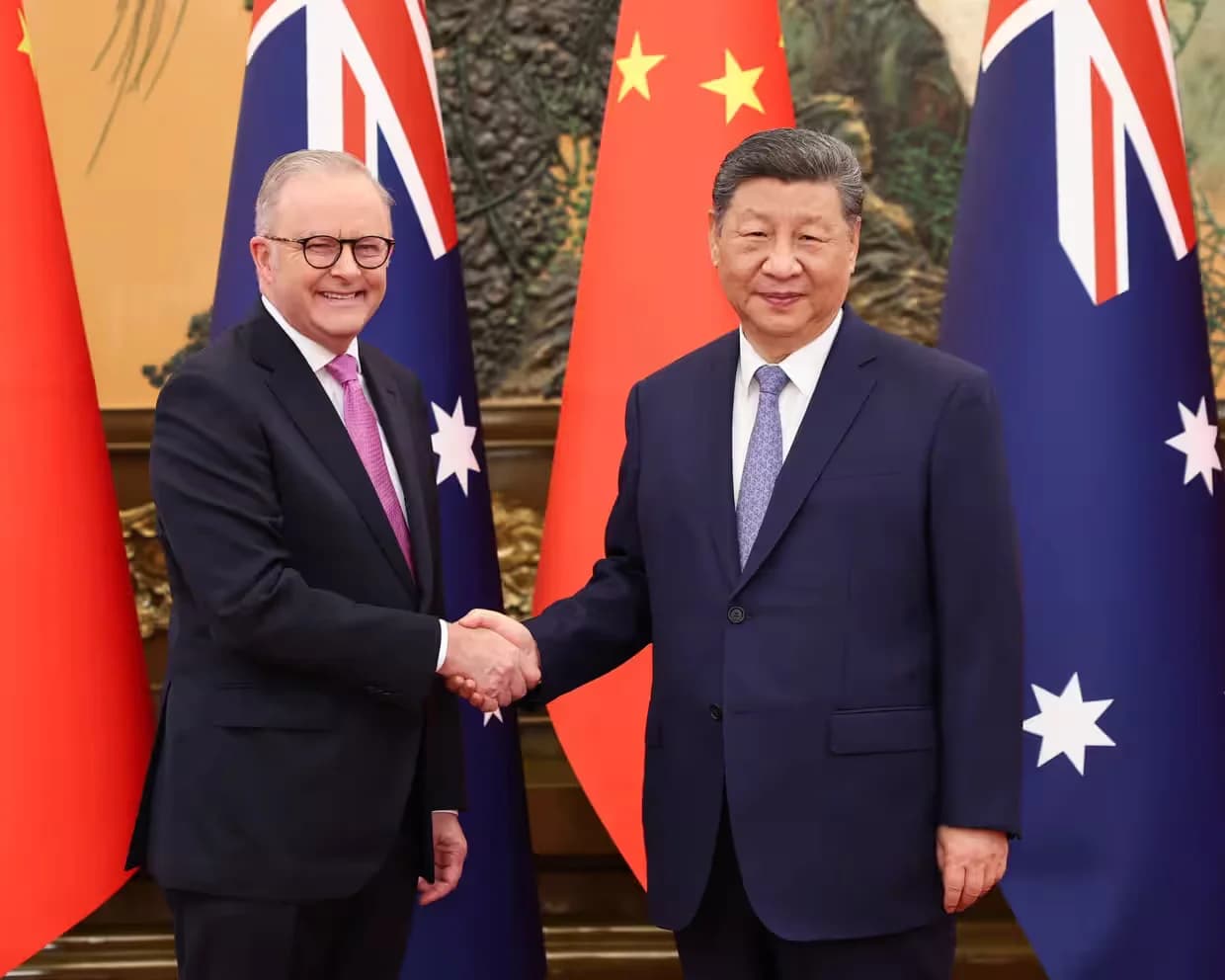
Chinese President Xi Jinping has called on Australia to maintain its course of cooperation with China despite growing geopolitical instability and escalating trade tensions driven by U.S. President Donald Trump. During a meeting in Beijing on Tuesday, Prime Minister Anthony Albanese’s second with Xi, the Chinese leader stressed the importance of safeguarding recently stabilized bilateral ties, The Guardian reported. “No matter how the international landscape may evolve, we should uphold this overall direction unswervingly,” Xi said at the Great Hall of the People, speaking through an interpr
Chinese President Xi Jinping has called on Australia to maintain its course of cooperation with China despite growing geopolitical instability and escalating trade tensions driven by U.S. President Donald Trump. During a meeting in Beijing on Tuesday, Prime Minister Anthony Albanese’s second with Xi, the Chinese leader stressed the importance of safeguarding recently stabilized bilateral ties, The Guardian reported. “No matter how the international landscape may evolve, we should uphold this overall direction unswervingly,” Xi said at the Great Hall of the People, speaking through an interpreter. Albanese, currently on a six-day visit to China, echoed Xi’s sentiment, saying: “I note your comments in your opening remarks about seeking common ground while sharing differences. That approach has indeed produced very positive benefits for both Australia and for China.” The meeting comes after a turbulent period in the Australia-China relationship, marked by Beijing’s imposition of $20bn in trade sanctions from May 2020 over a range of grievances, including foreign investment restrictions, national security laws, and Canberra’s call for an independent inquiry into the origins of the Covid-19 pandemic. Following the meeting, Albanese told reporters that he had not discussed the controversial lease of the Port of Darwin, an issue both Labor and the Coalition pledged during the last election campaign to address, including potentially using taxpayer funds to regain control from a Chinese-linked firm. China has previously objected to these plans. The prime minister did, however, raise the case of Chinese-Australian academic Yang Hengjun, who was sentenced to death with a suspended execution in February 2024. While acknowledging that a swift resolution was unlikely, Albanese said: “President Xi Jinping and I agreed dialogue must be at the centre of our relationship. If you don’t have communication, you can have misadventure and misinterpretation.” Albanese also reiterated his government’s approach to diplomacy on sensitive issues, promising “patient, calibrated advocacy.” Amid mounting U.S. pressure over the future of Taiwan, Albanese reaffirmed Australia’s commitment to “the status quo.” The Trump administration has reportedly pushed Canberra to clarify whether it would commit troops to any potential conflict with China over Taiwan. The Albanese government has resisted taking a definitive stance. Coalition senator James Paterson noted that the U.S. itself maintains strategic ambiguity under the Taiwan Relations Act of 1979 and argued it would be inappropriate to expect Australia to adopt a clearer policy. Albanese said he also raised concerns with Xi about a Chinese navy live-fire exercise earlier this year off the New South Wales coast. He acknowledged that China had acted within international law, but stressed concerns about the exercise's timing and notification. “I said what I said at the time: it was within international law … but we were concerned about the notice and the ways that it happened, including the live fire exercises,” he said. The prime minister was expected to hold further talks with Chinese Premier Li Qiang later that day. The visit was not without friction. Earlier in the day, security guards confronted Australian journalists filming at Beijing’s historic Drum and Bell Towers. Journalists from major outlets, including ABC, SBS, Nine, Seven and Sky News, were escorted by Australian diplomatic staff and had secured written permission to film. Despite this, up to eight security officers approached them, questioned their authorization, and demanded footage. Australian embassy staff intervened, and the journalists were ultimately allowed to leave without incident. ABC foreign affairs reporter Stephen Dziedzic described the situation as tense but not physically threatening. “An Australian official posted to the Beijing embassy pushed back forcefully,” he said. “When it looked like one of the guards might block one of the camera operators, she intervened immediately, telling them to step back. It was deftly done.” Asked about the confrontation, Albanese told reporters: “China has a different system obviously with the media, but certainly I am here, being accountable, I came straight here, and I’m going straight back.” China’s tight control over media and censorship of both citizens and foreign journalists remains a key point of divergence between the two countries. Meanwhile, Deputy Opposition Leader Sussan Ley criticized China’s military actions and influence in the Indo-Pacific, urging Albanese to take a firmer stance. “The prime minister should speak frankly about the increasing influence that China has in the region and speak about the importance to Australia of the US relationship,” she said. Ley also condemned China’s recent live-fire exercises, saying they endangered civil aviation and disrespected Australia’s sovereignty.



Comments
No comments yet. Be the first to share a thought.