
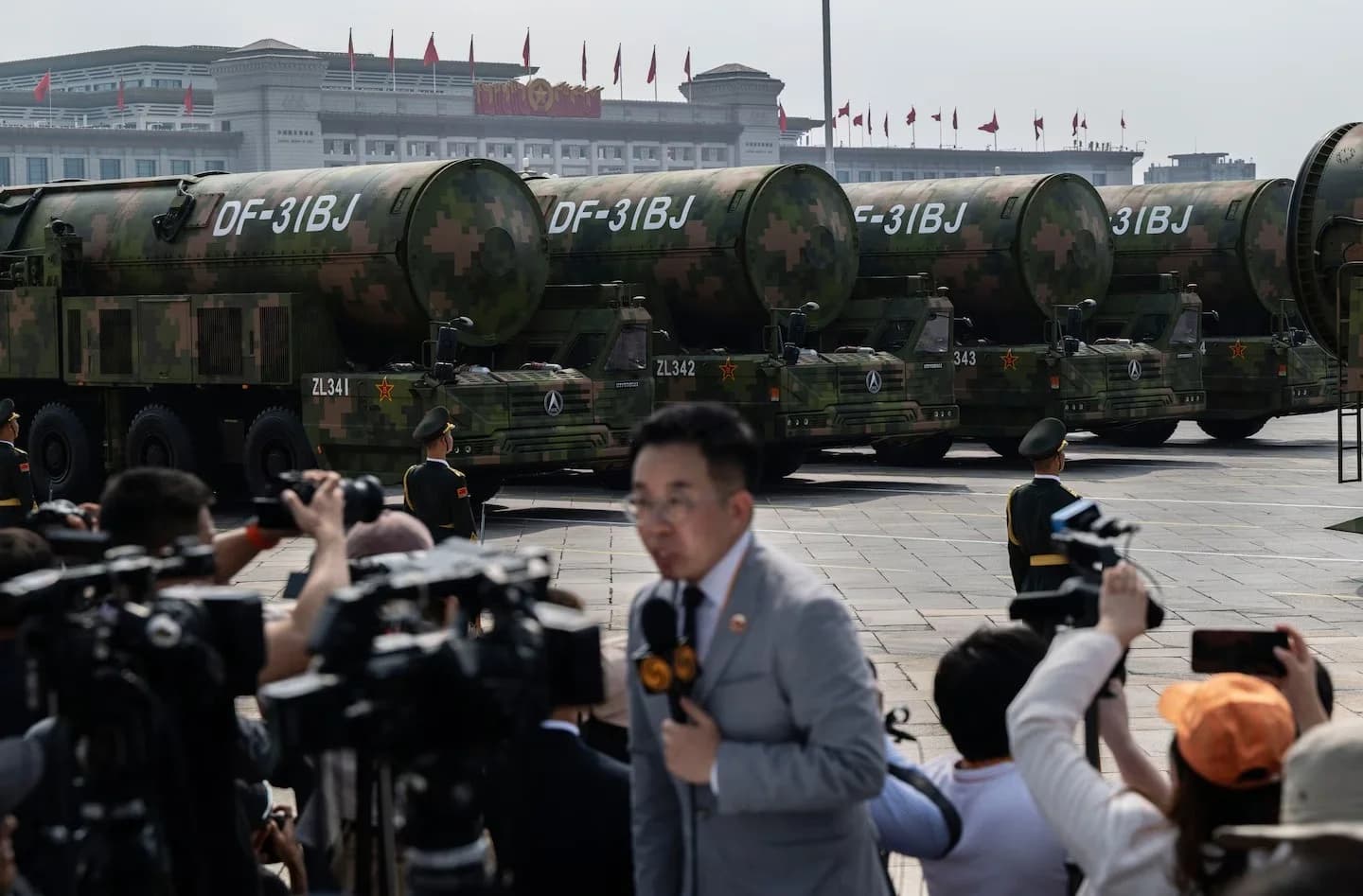
China’s nuclear weapons program has undergone one of the world’s most dramatic military transformations in recent years, signaling a shift that could redefine the global balance of power and heighten strategic tensions with the United States. After China’s last confirmed nuclear test in 1996, independent estimates placed its stockpile between 200 and 300 warheads. In 2020, the Pentagon’s annual report assessed that China held numbers in the “low 200s.” But since then, Beijing has expanded its nuclear arsenal at an unprecedented pace. By the end of last year, the Pentagon estimated that China n
China’s nuclear weapons program has undergone one of the world’s most dramatic military transformations in recent years, signaling a shift that could redefine the global balance of power and heighten strategic tensions with the United States.
After China’s last confirmed nuclear test in 1996, independent estimates placed its stockpile between 200 and 300 warheads. In 2020, the Pentagon’s annual report assessed that China held numbers in the “low 200s.” But since then, Beijing has expanded its nuclear arsenal at an unprecedented pace. By the end of last year, the Pentagon estimated that China now possesses more than 600 nuclear warheads, with projections that the figure could reach 1,000 by 2030.
Alongside the numerical increase, China has heavily expanded its main nuclear testing facility in the country’s remote northwest. Satellite imagery has revealed new buildings, additional power lines, and deep underground shafts. Experts say these chambers could allow China to conduct low-yield or subcritical nuclear tests, which help assess weapon safety and reliability without producing an explosive nuclear detonation—making them harder to detect.
The first major global wake-up call came in 2021 when analysts discovered vast missile silo fields under construction in northwest China. By 2024, China had built nearly 350 missile silos, a number approaching that of the United States. Traditionally, China relied almost entirely on road-mobile intercontinental ballistic missiles (ICBMs) mounted on trucks, which could move unpredictably to reduce vulnerability. The construction of fixed silos signaled a dramatic broadening of Beijing’s nuclear posture.
China is now openly demonstrating that it aims to operate a full nuclear triad. This includes nuclear-capable missiles launched from land, long-range bombers dropping nuclear warheads from the air, and submarines capable of firing nuclear-armed ballistic missiles from underwater. During a high-profile military parade in Beijing this September, China showcased several new nuclear-capable systems, including the DF-61—a mobile ICBM believed to be capable of striking the continental United States. Beijing also displayed a new liquid-fueled missile that Chinese analysts claim can reach any point on the globe and strike multiple targets simultaneously using a mix of nuclear, conventional, or decoy warheads, complicating U.S. missile-defense systems.
Chinese officials have neither denied nor explained the rapid expansion, nor acknowledged a shift from their longstanding “minimum deterrent” doctrine. Officially, China still states it will not use nuclear weapons unless attacked first. However, Chinese leaders increasingly speak about the need for a stronger “strategic counterbalance,” a phrase signaling that Beijing views a more formidable nuclear force as essential to reshaping global power.
President Xi Jinping reinforced this direction in March 2021, calling for an accelerated buildup of “advanced strategic deterrence” as part of sweeping reforms within the People’s Liberation Army Rocket Force. Analysts believe Xi may view nuclear strength as a crucial component to achieving “unification” with Taiwan, the self-governing island democracy that Beijing claims as its territory.
Senior U.S. defense officials argue that the nuclear buildup is tied directly to China’s preparations for a potential conflict over Taiwan. Gen. Anthony J. Cotton, commander of U.S. Strategic Command, told Congress that China’s investments in new land-, sea-, and air-based nuclear capabilities are part of its broader strategy for a future Taiwan contingency. U.S. intelligence agencies say Xi has instructed the PLA to be ready to seize Taiwan by 2027, though this does not necessarily mean an invasion is planned for that year.
A larger and more flexible Chinese nuclear force complicates American strategic calculations, potentially deterring Washington from intervening militarily in the region and raising the risk of escalation in any crisis involving Taiwan.
China’s rapid nuclear expansion represents far more than a modernization effort. It signals a fundamental shift in Beijing’s strategic thinking, an attempt to match or deter U.S. power, and a restructuring of the global nuclear landscape. As China bolsters its capabilities, the world enters one of the most uncertain and competitive nuclear eras since the Cold War.
As Victor Gao of the Center for China and Globalization stated, “Washington is increasingly getting the message.”



Comments
No comments yet. Be the first to share a thought.