
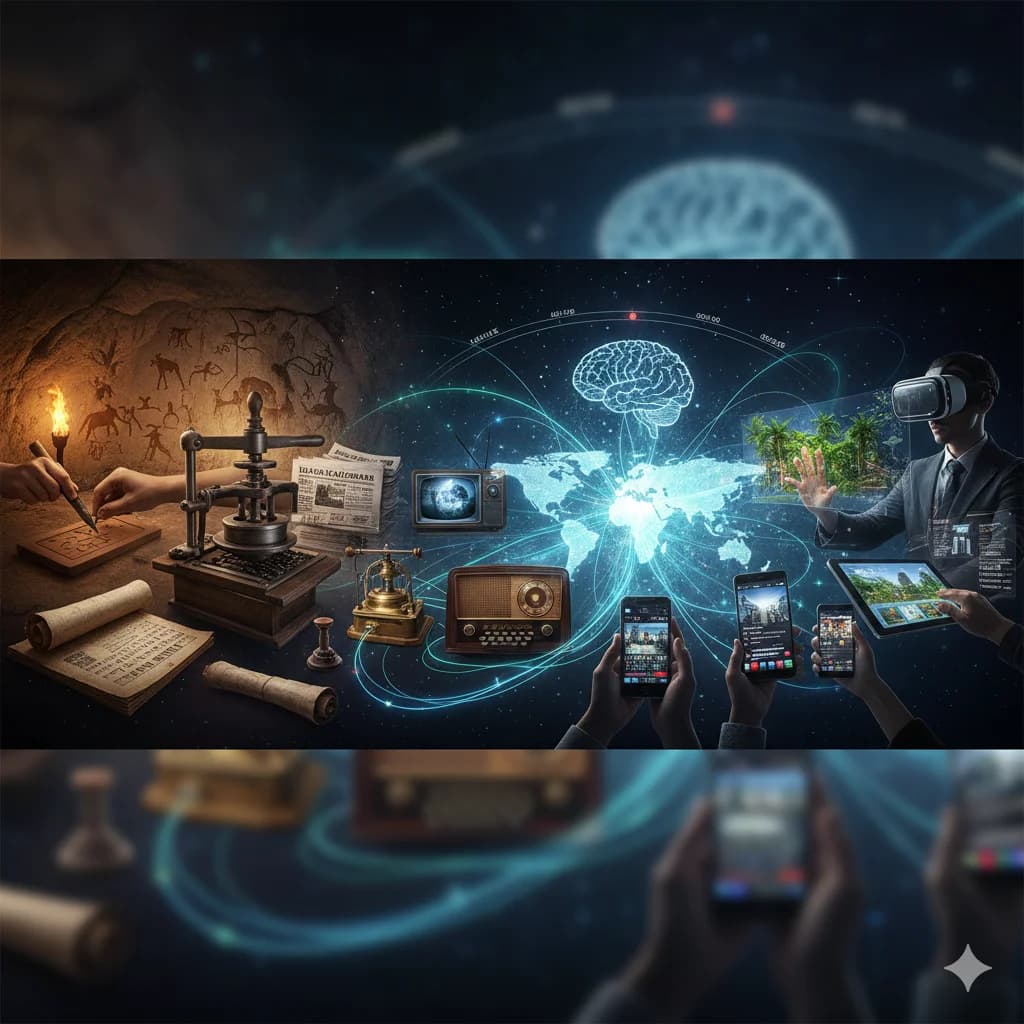
Have you ever had a really good idea, a funny story, or an important piece of news you just had to share? That feeling is one of the oldest human feelings there is. For as long as we've been around, we've been desperate to connect with each other, to share what we see, know, and feel. The story of technology is really just the story of us finding new, faster, and bigger ways to do that. Let's take a walk from the very beginning to... well, to whatever is coming next. Trapping an Idea (The First "Media") At first, "technology" was just our voice. We told stories around a fire. But a spoke
Have you ever had a really good idea, a funny story, or an important piece of news you just had to share? That feeling is one of the oldest human feelings there is. For as long as we've been around, we've been desperate to connect with each other, to share what we see, know, and feel. The story of technology is really just the story of us finding new, faster, and bigger ways to do that. Let's take a walk from the very beginning to... well, to whatever is coming next.
Trapping an Idea (The First "Media")
At first, "technology" was just our voice. We told stories around a fire. But a spoken word is like smoke, it's there, and then it's gone. The first big problem was: How do you make an idea stay? We started by painting on cave walls. These were the first "media", a way to tell a story. Did you know? And that lasted longer than a voice. Then, thousands of years ago, people in places like Sumeria and Egypt started using little marks on clay and stone to represent words. This was writing. It was revolutionary! For the first time, a person's thoughts could travel through time. A king could give an order, or a poet could write a song, and people years later could read it. Then, paper was invented, which was a lot easier to carry than a chunk of stone. This was the media industry for thousands of years: a few people who knew how to read and write, slowly copying things by hand.
The Great Copy Machine (The Printing Press)
This slow, by-hand system worked for a long time. But what if you wanted everyone to know something? Around the year 1440, a man named Johannes Gutenberg had an idea. He created the printing press. It was like a machine that could "stamp" an entire page of words at once. Instead of one person taking months to copy one book, Gutenberg could make hundreds of copies. This one invention changed the world. It was the birth of "mass media"—media for the masses. Amazing
News
: The first newspapers popped up. They were just single sheets of paper (called "broadsheets") telling people the latest news from other towns or from a war. This was the beginning of journalism.
Ideas
: People could share new ideas about science, religion, and government. The printing press fueled huge changes in society because information could suddenly spread.
The Electric Spark (The Telegraph, Radio)
For the next few hundred years, things got faster, but the main idea was the same: print on paper, then move it (by horse, by ship, by train). The next big question was: How can we make an idea move faster than a person? The answer was electricity. First came the telegraph (in the 1840s). It was a "talking wire." Using dots and dashes (Morse Code), a journalist at a battlefield could send news back to the city in minutes, not days. News became "instant" for the first time. Then, someone asked an even crazier question: "What if we could send our voices?" In 1876, the telephone was born. But that was still one person to one person. The real media breakthrough was radio (in the 1890s). This was true magic. Scientists figured out how to send sound through the air itself. By the 1920s, families would gather around a box in their living room to hear news, music, and stories. A single person like a president or a news announcer could speak to millions of people at the exact same moment.
Pictures on the Air (Television)
Once we could send sound, the next step was obvious: "What if we could send pictures, too?" This led to television. In the 1950s, TV took over. It combined the instant power of radio with the storytelling power of pictures. For journalism and media, this was a revolution. We didn't just hear about a big event; we saw it. We watched rockets launch into space, saw leaders give speeches, and (sadly) watched wars play out in our own homes. For 50 years, if you wanted to know what was happening, you turned on the TV news.
The World in Your Pocket (The Internet)
For all this time, "media" worked in one direction. A big company (a newspaper, a radio station, a TV network) decided what was important, and they sent it out to you. You were the audience. Then, the Internet changed the rules of the game. It started in the 1990s as a way for computers to share information. But it quickly became a "network of everyone." And with it, everything changed:
You Became the Creator
: Suddenly, you didn't need a printing press or a TV station. Anyone could start a "blog" (an online journal) and be a writer. Anyone could film a video and put it on YouTube and be a filmmaker.
News 24/7
: News was no longer at 6 PM. It was all the time, from everywhere.
Social Media
: Platforms like Facebook and Twitter (now X) turned communication into a conversation. News wasn't just what journalists reported; it was what your friends were sharing.
Mobile
: Finally, the smartphone put all of it, the printing press, the radio, the TV, and the internet into your pocket.
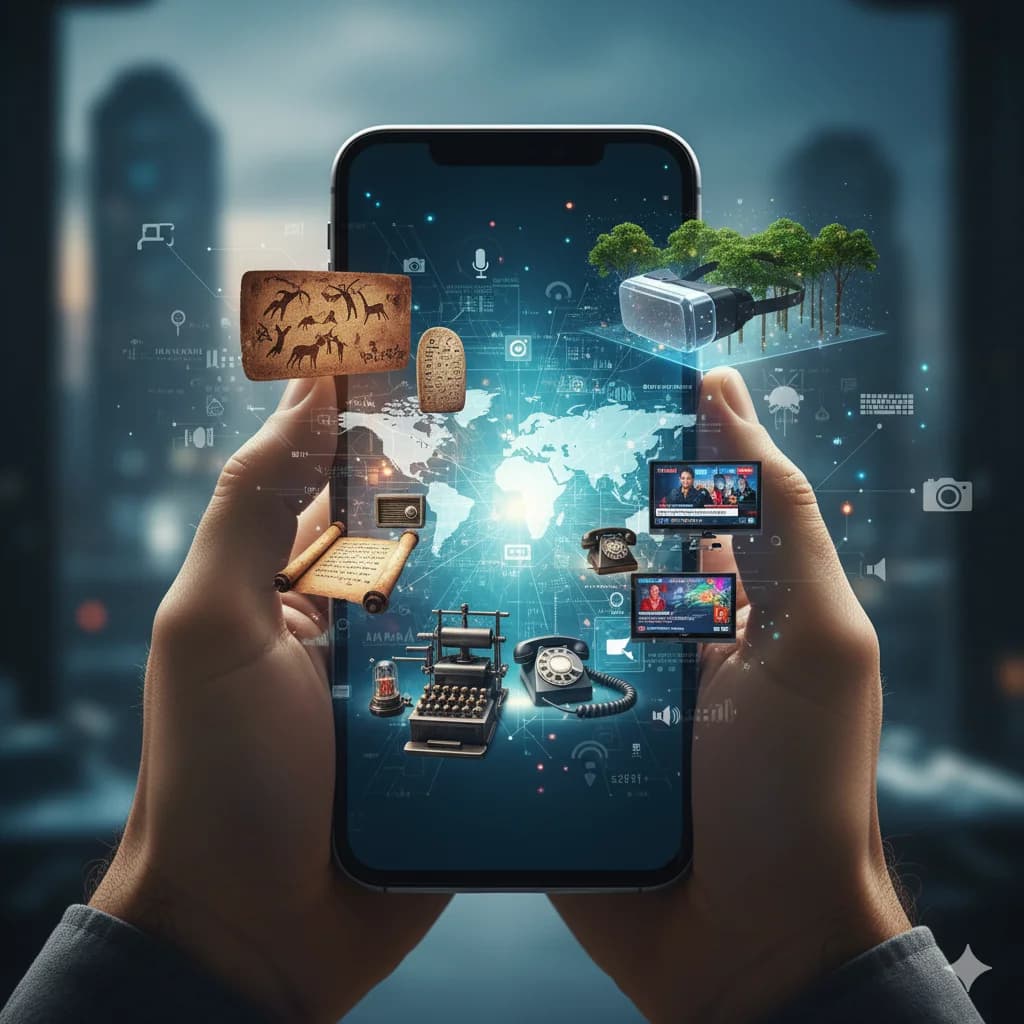
The journey from primal communication to cutting-edge digital experiences, all summarized in one device. Your smartphone holds the 'world in your pocket,' showcasing millennia of technological progress.
What's Next? (The Future)
So, where is this all going? We are in the middle of the next big shift right now.
Artificial Intelligence (AI)
: This is technology that can "think" and "create." In media, AI is already here. It can help journalists sort through huge amounts of data to find a story. It can write simple reports (like sports scores or company earnings). For you, it creates personalized "for you" pages, learning what you like and showing you more of it.
Virtual and Augmented Reality (VR/AR)
: This is the idea of immersive media.
Virtual Reality (VR)
: Instead of just watching a report about a rainforest, what if you could put on a headset and "stand" in the middle of it?
Augmented Reality (AR)
: This is when technology adds a layer on top of the real world. Imagine pointing your phone's camera at a building and seeing its history pop up. The future of media is a world where the line between the real and the digital blur. It will be more personal, more intelligent, and more immersive than ever.
The one thing that won't change? That very human feeling of having a story to tell and wanting, more than anything, to share it. The technology will just keep getting more amazing.



Comments
No comments yet. Be the first to share a thought.