
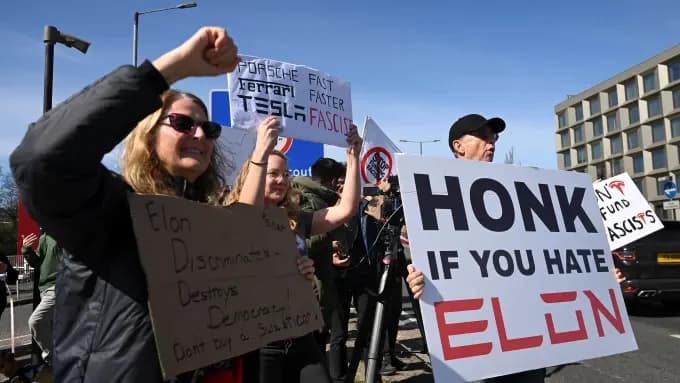
A wave of protests has erupted across the United States, Canada, and Europe, targeting Tesla showrooms in response to Elon Musk’s role in governmental restructuring efforts. The demonstrations, collectively known as the "Tesla Takedown," reflect mounting public discontent with Musk’s leadership of the Department of Government Efficiency (DOGE) and its aggressive policies aimed at cutting federal staffing and budgets. The protests began after Musk, as head of DOGE, spearheaded significant reductions in government spending, a move critics argue has weakened essential public services and disprop
A wave of protests has erupted across the United States, Canada, and Europe, targeting Tesla showrooms in response to Elon Musk’s role in governmental restructuring efforts. The demonstrations, collectively known as the "Tesla Takedown," reflect mounting public discontent with Musk’s leadership of the Department of Government Efficiency (DOGE) and its aggressive policies aimed at cutting federal staffing and budgets. The protests began after Musk, as head of DOGE, spearheaded significant reductions in government spending, a move critics argue has weakened essential public services and disproportionately affected vulnerable populations. Activists have mobilized at Tesla locations, urging people to sell their Tesla vehicles and shares as a form of financial resistance against Musk’s influence. On March 29, 2025, the movement reached a peak with a "Global Day of Action," featuring over 200 demonstrations at Tesla showrooms across the United States, alongside protests in Canada and Europe. The intensity of these protests varied, ranging from peaceful gatherings to more aggressive confrontations. In League City, Texas, protesters gathered outside a Tesla showroom to voice their concerns over Musk’s influence on federal policies, particularly regarding potential cuts to Social Security. According to the Houston Chronicle, demonstrators demanded an end to Musk’s role in shaping government policy, arguing that corporate interests should not dictate public administration. Internationally, the movement has seen varying levels of participation. In Dublin, Ireland, only six protesters assembled outside a Tesla showroom, highlighting the campaign’s global reach but also its inconsistent momentum. While most protests have remained peaceful, some incidents have escalated into violence and vandalism. In Las Vegas, a man was arrested for allegedly setting fire to multiple Tesla vehicles at a repair facility, an act authorities have labeled as domestic terrorism. Law enforcement agencies have since established a task force to prevent further attacks on Tesla properties, recognizing the growing tension surrounding Musk’s political influence. In response to the protests, lawmakers in New York have proposed legislation to revoke Tesla’s permits for direct sales locations, citing Musk’s ties with the Trump administration and his role in shrinking the federal workforce. The move signals a broader political push to limit Musk’s influence over government operations. Amid the controversy, Musk has announced his intention to resign from his role at DOGE by the end of May, claiming that he has successfully reduced the U.S. deficit. Despite the backlash, he remains confident in Tesla’s future, urging employees and investors to stay committed as the company navigates declining sales and stock values. The "Tesla Takedown" movement highlights the complex intersection of corporate leadership and public governance. As protests continue and legislative actions unfold, the situation underscores the broader debate over the role of private sector leaders in shaping government policies and the consequences of their involvement.

Comments
No comments yet. Be the first to share a thought.