
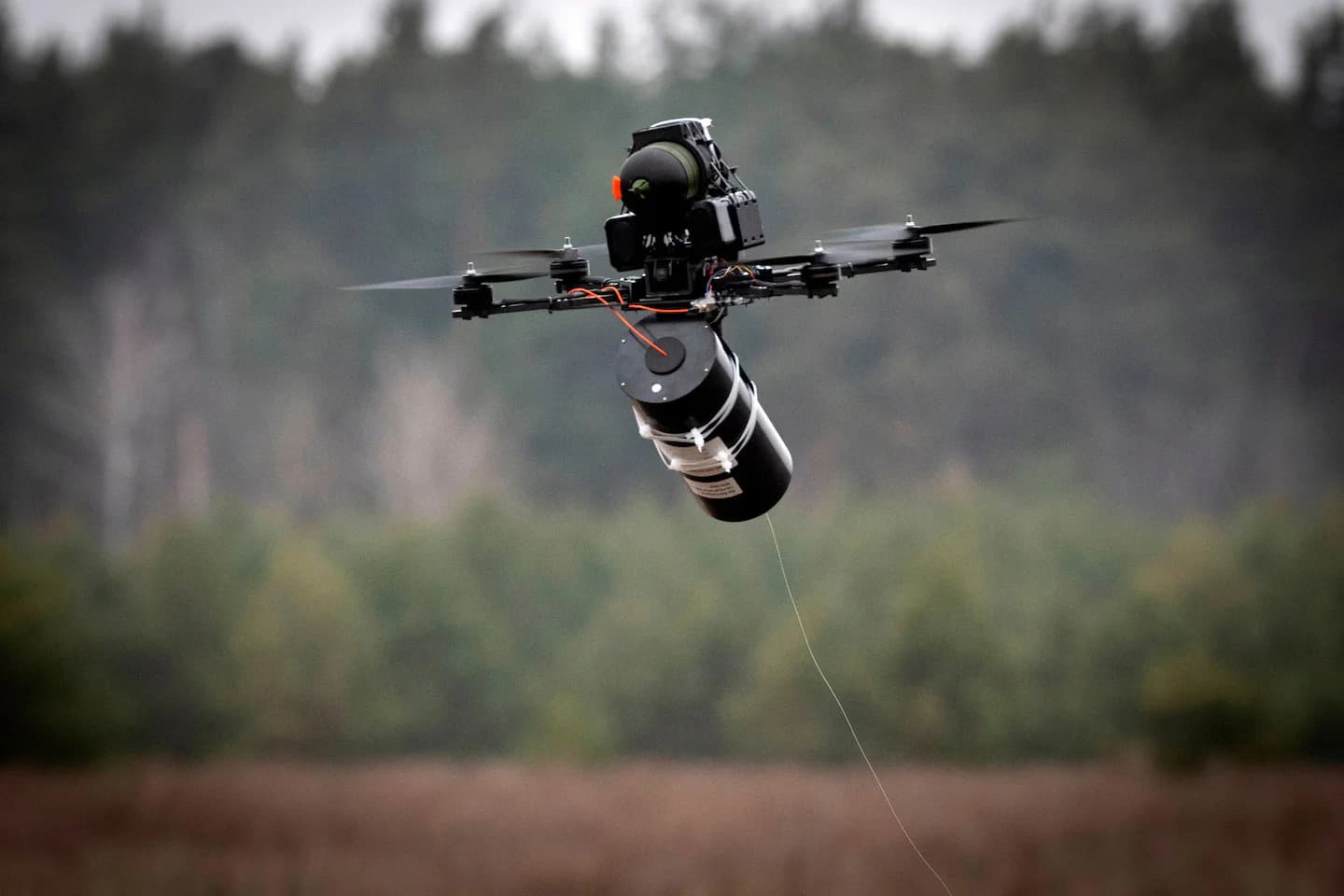
An explosive-laden fiber-optic drone strike by Hezbollah on Sunday killed a 19-year-old Israeli soldier and wounded several others in southern Lebanon, underscoring an emerging battlefield challenge for Israeli forces during a fragile ceasefire. The attack struck an Israeli armored unit in the Lebanese town of Taybeh, killing Sergeant Idan Fooks and injuring six other soldiers, according to Israeli military officials and regional reports. When a medical evacuation helicopter arrived at the scene, Hezbollah launched two additional drones. Israeli forces intercepted one of them, while the second
An explosive-laden fiber-optic drone strike by Hezbollah on Sunday killed a 19-year-old Israeli soldier and wounded several others in southern Lebanon, underscoring an emerging battlefield challenge for Israeli forces during a fragile ceasefire.
The attack struck an Israeli armored unit in the Lebanese town of Taybeh, killing Sergeant Idan Fooks and injuring six other soldiers, according to Israeli military officials and regional reports.
When a medical evacuation helicopter arrived at the scene, Hezbollah launched two additional drones. Israeli forces intercepted one of them, while the second struck nearby without causing further casualties, officials said.
The incident occurred during a ceasefire that had been extended for three weeks, with Israeli Prime Minister Benjamin Netanyahu accusing Hezbollah of repeated violations of the truce.
Israeli military officials said fiber-optic guided drones, controlled through thin cables rather than radio or satellite links, have exposed gaps in existing air defense systems, which rely heavily on electronic jamming and signal disruption.
The Israel Defense Forces acknowledged they entered the Lebanon campaign without sufficient countermeasures for the technology, despite its prior use in the Russia–Ukraine war and by Palestinian fighters in Gaza following the October 7, 2023 attacks.
Hezbollah announced it began deploying fiber-optic drones during the escalation of fighting that began March 2. Israeli assessments initially believed the drones had a limited range of a few kilometers, but later determined they could be launched from distances of up to 15 kilometers.
Officials also said the drones have bypassed Israel’s “Trophy” active protection system mounted on Merkava tanks, designed to intercept incoming projectiles.
In response, Israeli forces have begun improvising defensive measures, including fishing nets, camouflage nets, and soccer nets over military positions, alongside small-arms drills to shoot down incoming drones.
Israeli military officials told the Associated Press the drones are believed to be locally produced using commercially available components, including off-the-shelf drone frames, small explosive charges, and transparent fiber-optic wire.
Military analysts say the tactic reflects a broader shift in modern warfare, where inexpensive and adaptable systems are increasingly challenging advanced defense networks.



Comments (1)
Very great post. I just stumbled upon your weblog and wished to mention that I've truly loved surfing around your blog posts. In any case I will be subscribing to your rss feed and I'm hoping you write once more soon!