
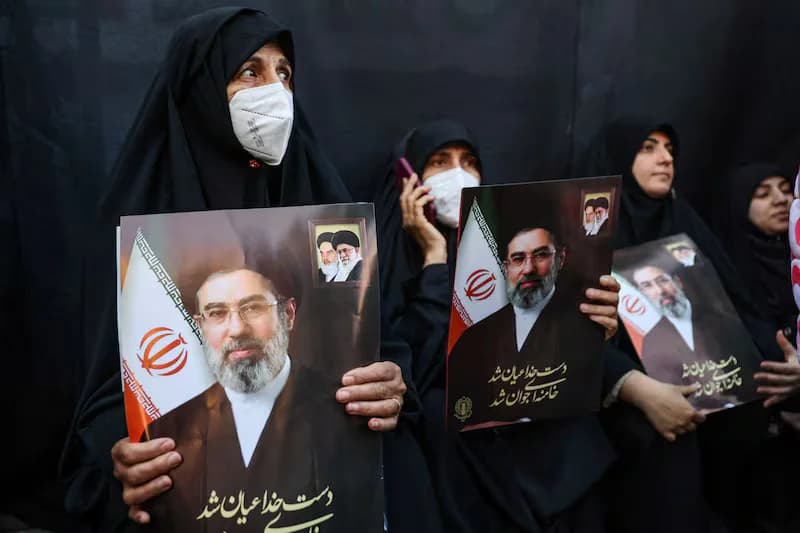
Iran’s Supreme Leader Mojtaba Khamenei issued a defiant message on Thursday declaring that the United States has “no place” in the Persian Gulf, as the war between Iran and a U.S.-Israel coalition entered its ninth week. Khamenei, the son of longtime Supreme Leader Ali Khamenei , took power in early March after his father was killed in an Israeli airstrike on February 28, the opening day of the conflict known as Operation Epic Fury . The message attributed to Khamenei was not delivered in person. Instead, it was read by a state television anchor over a still image of the leader, with no audio
Iran’s Supreme Leader Mojtaba Khamenei issued a defiant message on Thursday declaring that the United States has “no place” in the Persian Gulf, as the war between Iran and a U.S.-Israel coalition entered its ninth week.
Khamenei, the son of longtime Supreme Leader Ali Khamenei, took power in early March after his father was killed in an Israeli airstrike on February 28, the opening day of the conflict known as Operation Epic Fury.
The message attributed to Khamenei was not delivered in person. Instead, it was read by a state television anchor over a still image of the leader, with no audio or video appearance from him. The absence of direct communication has raised ongoing questions about his condition, with reports from Iran International and The Japan Times indicating he may have been seriously injured in the same strike.
In the statement, Khamenei said Iran would take control of regional security and the strategic Strait of Hormuz. In practice, however, shipping through the strait has largely halted since the war began, effectively creating a blockade that has disrupted global energy flows.
Oil markets reacted sharply. Brent crude futures rose to about $126 per barrel at the peak of the disruption before easing to around $114, still up more than 8% on the week, according to CNBC. In response, the International Energy Agency announced an emergency release of 400 million barrels from strategic reserves to stabilize supply, the agency said.
Khamenei also signaled Iran's position ahead of ongoing post-ceasefire nuclear negotiations, rejecting U.S. demands that Iran accept strict limits on its nuclear program and surrender stockpiles of highly enriched uranium, according to the Associated Press. He described Iran's nuclear and missile capabilities as national assets that would not be negotiated away.
The maritime confrontation has intensified on both sides. The United States has implemented a naval blockade targeting Iranian oil exports and shipping, with U.S. forces seizing Iran-linked tankers and restricting maritime movement. U.S. President Donald Trump said the blockade is "somewhat more effective than the bombing" and described Iran as "choking like a stuffed pig," in remarks to Axios.
Despite the escalation, negotiations remain underway but stalled. U.S. President Donald Trump said talks are continuing “telephonically” after an attempted in-person meeting in Pakistan collapsed over the weekend.
U.S. Federal Reserve Chair Jerome Powell warned that the energy shock driven by disrupted Gulf supply could complicate inflation outlooks and economic stability if sustained. Iran has since issued a direct military warning, threatening "long and painful strikes" on U.S. positions if Washington renewed its attacks, while reasserting its control over the Strait of Hormuz, according to Reuters. The warning complicates U.S. efforts to build a coalition to reopen the waterway, further dimming prospects for a near-term resolution to the shipping crisis.



Comments
No comments yet. Be the first to share a thought.