
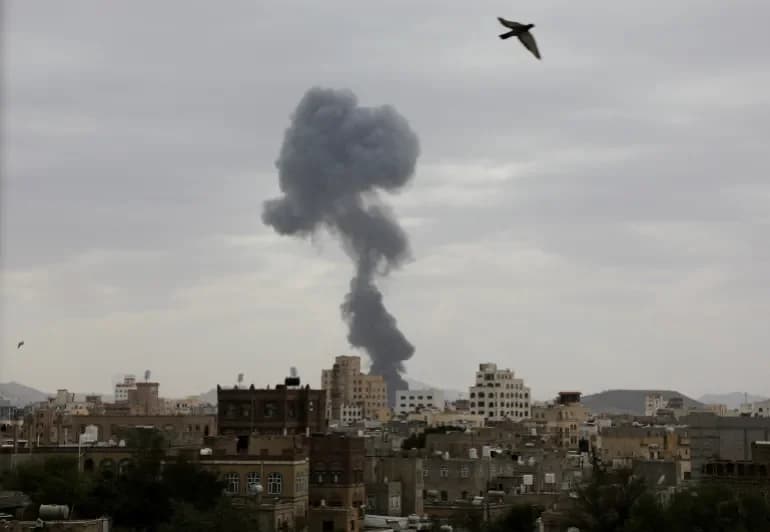
The Israeli military has confirmed conducting airstrikes on multiple targets in Yemen, including the airport in Sanaa and key infrastructure facilities such as power stations and a concrete factory. In an official statement, the Israeli army said that the al-Imran cement factory, located north of Sanaa, was among the targets hit. The military emphasized that the operation was sanctioned by both the Commander of the Air Force and the Chief of Staff. Israel asserted that it will continue to take strong action against any groups it perceives as a threat, stating, “The military will continue to
The Israeli military has confirmed conducting airstrikes on multiple targets in Yemen, including the airport in Sanaa and key infrastructure facilities such as power stations and a concrete factory. In an official statement, the Israeli army said that the al-Imran cement factory, located north of Sanaa, was among the targets hit. The military emphasized that the operation was sanctioned by both the Commander of the Air Force and the Chief of Staff. Israel asserted that it will continue to take strong action against any groups it perceives as a threat, stating, “The military will continue to act and strike with force any group that poses a threat to Israel.” The attacks on Sanaa followed a similar strike the previous day in Hodeidah, where 20 Israeli fighter jets bombed both the city’s port and a cement factory in nearby Bajil. According to Houthi-affiliated Al Masirah TV, the Yemeni Health Ministry reported that at least three people were killed and 35 injured in the Bajil factory attack. Israeli military officials claimed that these strikes were aimed at crippling the Houthis’ military capabilities, describing the targeted cement factory as a key “economic resource” used in constructing tunnels and military infrastructure. They further accused the Houthis of acting under “Iranian guidance and funding” to destabilize the region and obstruct global maritime operations. Despite Houthi claims that the attacks were a joint Israeli-American operation, a U.S. defense official told Al Jazeera that the United States did not participate in the strikes.
Retaliation After Tel Aviv Airport Strike
According to Israeli journalist Meron Rapoport of Local Call, Israel's strikes in Yemen are a direct response to a Houthi missile attack that recently struck near Ben Gurion Airport in Tel Aviv. He described the missile impact as a significant embarrassment for the Israeli government, highlighting failures in its air defense systems. “This was a real internal and external blow to Israel, especially as it tries to convince its citizens and the international community that it can sustain ongoing military campaigns in Gaza, Lebanon, and Syria,” Rapoport said. He also noted that Israel’s military actions in Yemen are closely coordinated with the U.S., given Washington’s leading role in the region’s intensified aerial operations.
Criticism of the Sanaa Airport Strike
Sultan Barakat, a public policy professor at Hamad Bin Khalifa University in Qatar, criticized Israel’s attack on Sanaa International Airport, calling it “pure vandalism.” Barakat argued that the airport has no significant strategic value and is heavily restricted by the United Nations and the Saudi-led coalition. “The only airline operating there is Yemenia, and it only flies to Amman. The airport primarily serves people seeking medical treatment and humanitarian aid,” Barakat explained. He warned that damaging the airport could severely disrupt humanitarian operations in Yemen, one of the world’s poorest nations. “It’s not a justified target,” he said, adding that the attack seemed more symbolic than tactical: “They hit our airport, so we’ll hit theirs.”



Comments
No comments yet. Be the first to share a thought.