
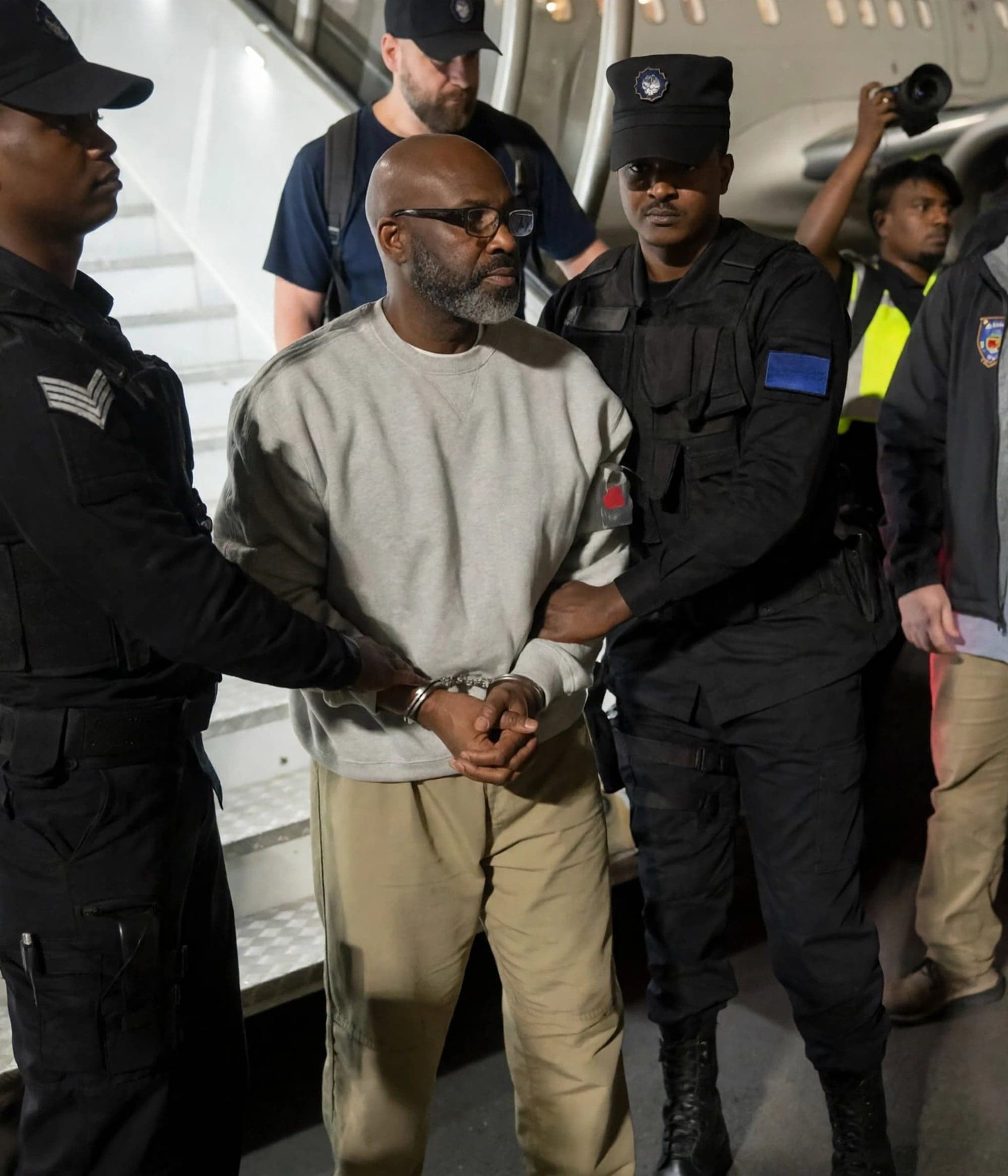
Jean Léonard Teganya, a Rwandan man accused of crimes linked to the 1994 Genocide against the Tutsi, arrived in Rwanda on the evening of Monday, November 9, 2026, from the United States, more than 30 years after the Genocide was stopped.
Videos shared by Igiheofficial show Teganya surrounded by security officers, with his hands handcuffed, after arriving in Rwanda.
Teganya had spent many years abroad, where he faced investigations over different accusations related to information he allegedly hid about his past during the Genocide against the Tutsi.
In 2019, a court in the United States found him guilty of five offences. Two were related to immigration fraud, while the other three involved making false statements under oath.
He was sentenced to 97 months in prison, equivalent to eight years and one month.
However, the offences for which he was convicted in the United States are different from the crimes he is accused of in Rwanda. His arrival in the country does not mean he has already been found guilty of genocide crimes. He still has the right to defend himself in court.
TEGANYA: THE MEDICAL STUDENT WHO FACED ACCUSATIONS LINKED TO THE GENOCIDE
Jean Léonard Teganya was born in 1971. Before the 1994 Genocide against the Tutsi, he was a medical student at the University of Rwanda, at the Butare campus.
In 1994, he was in his third year of medical studies and was also doing practical training at Butare University Teaching Hospital.
His activities during the Genocide later became part of legal cases in Canada and the United States.
Different witnesses accused him of taking part in attacks against Tutsi who had sought safety at Butare Hospital.
During court proceedings in the United States, prosecutors said Teganya was accused of being a member of the MRND political party and the Interahamwe militia. They also presented allegations linking him to crimes committed against Tutsi at the hospital.
Prosecutors presented witness statements from people who said he was involved in killings and other acts of violence against people who had sought refuge at the hospital.
However, these were allegations and witness statements presented during legal proceedings, not a final judgment by a Rwandan court.
HIS JOURNEY IN SEARCH OF REFUGE ABROAD
In July 1994, after the Genocide against the Tutsi had been stopped, Teganya left Rwanda and went to the Democratic Republic of Congo.
He later travelled to Kenya and India before arriving in Canada in 1999.
After reaching Canada, he applied for refugee status, but his application was rejected in 2002. He continued appealing the decision until 2012, when the rejection was finally confirmed.
During the process, Canadian authorities also examined allegations that he had taken part in attacks against Tutsi during the Genocide, especially at Butare Hospital.
After failing to obtain refugee status in Canada, Teganya crossed the border into the United States in 2014.
On August 3, 2014, he was arrested in Houlton, Maine, near the border between Canada and the United States.
At the time, he was facing accusations linked to war crimes and crimes against humanity.
HIS CASE IN THE UNITED STATES
After arriving in the United States, Teganya continued to face legal proceedings over information he had provided when applying for refugee status and immigration documents.
In September 2017, he was charged with five offences. Two were related to immigration fraud, while three involved making false statements under oath.
His case was heard in Boston, where prosecutors presented evidence and witness statements about information he had allegedly hidden concerning his past during the Genocide.
On April 5, 2019, a jury found him guilty of all five offences.
On July 1, 2019, he was sentenced to 97 months in prison.
He later appealed the court's decision. However, on May 17, 2021, the United States Court of Appeals upheld his conviction and sentence.
ARRIVES IN RWANDA AFTER MANY YEARS ABROAD
Teganya's arrival in Rwanda on Monday evening, November 9, 2026, marks another step in the country's efforts to bring people accused of crimes linked to the Genocide against the Tutsi to justice.
After spending many years in different countries and facing legal proceedings abroad, he is now expected to answer the charges against him before Rwandan courts.
However, his arrival does not mean the case is over. He has the right to know the charges against him, defend himself and present evidence in his favour as the court considers his case.

Comments
No comments yet. Be the first to share a thought.