
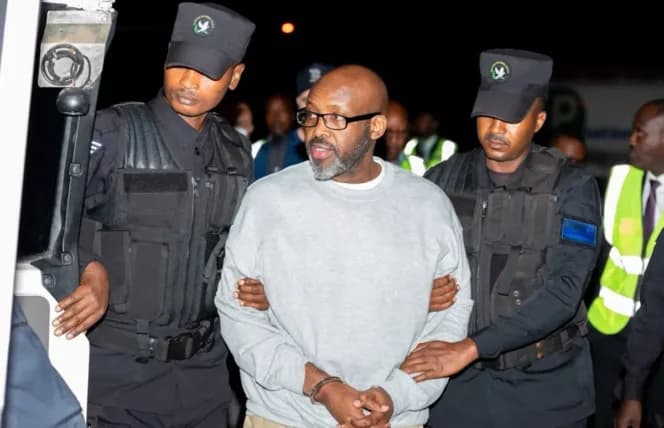
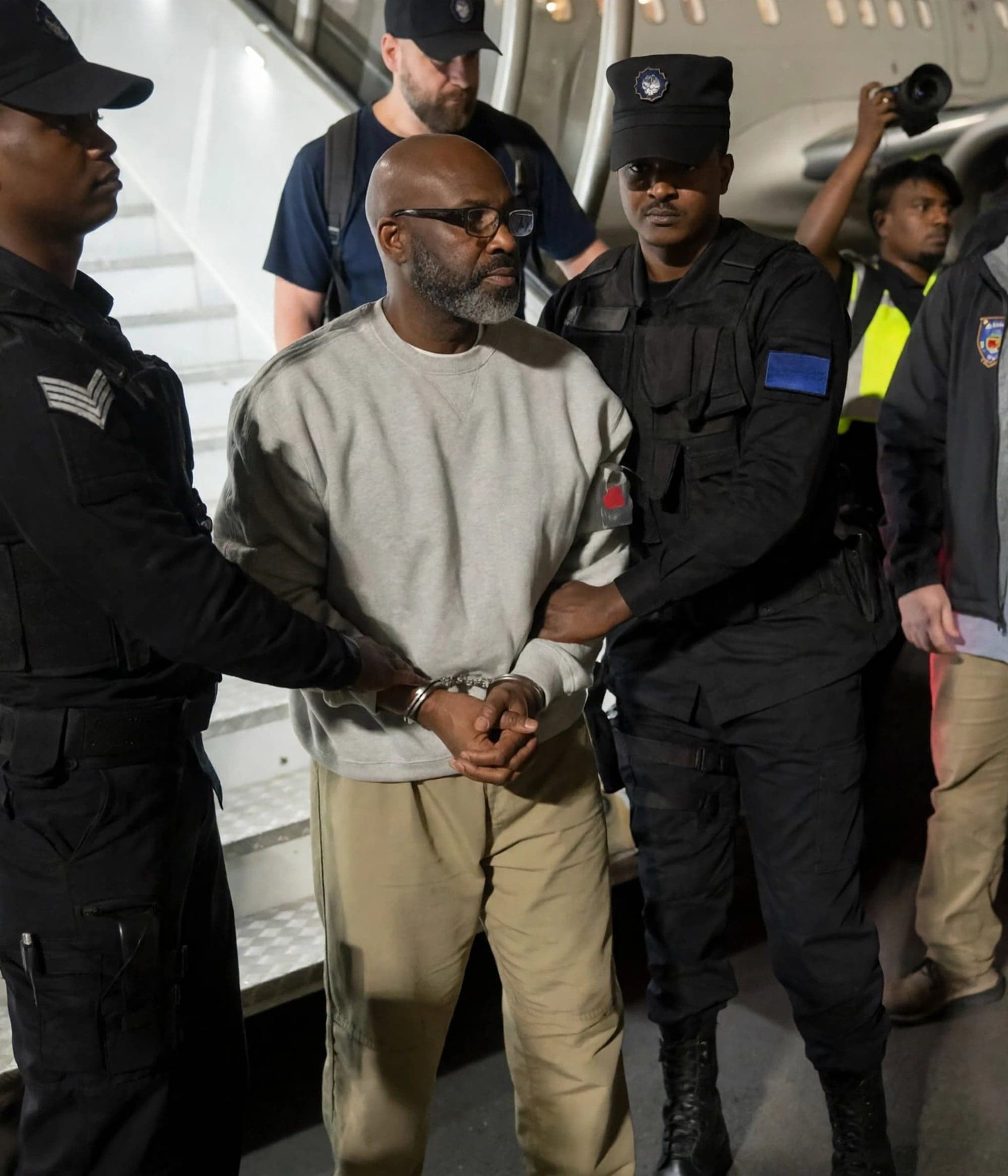
The United States has extradited Jean Léonard Teganya to Rwanda, where he is expected to face charges related to his alleged involvement in the 1994 Genocide against the Tutsi and crimes against humanity reportedly committed in the former Butare Prefecture. He arrived at Kigali International Airport on the evening of Monday, November 9, 2026, after spending more than 32 years outside Rwanda.
According to media outlets, including Radio TV10, Rwanda's National Public Prosecution Authority (NPPA) confirmed that it had received Teganya following his extradition by US authorities. Information published by KT Press indicates that the flight carrying him was initially expected to arrive in Kigali at around 11:00 a.m. but eventually landed at approximately 6:00 p.m.
Jean Léonard Teganya was born in 1971 in Gatumba Sector, Ngororero District, in Rwanda's Western Province. In 1994, he was a medical student at the former National University of Rwanda in Butare, now part of the University of Rwanda's Huye Campus. He was also undertaking practical training at Butare University Teaching Hospital.
During the 1994 Genocide against the Tutsi, US prosecutors presented evidence linking Teganya to the MRND political party and the Interahamwe militia. He was also accused of participating in efforts to identify and search for Tutsi who had sought refuge at Butare Hospital and in university student residences.
Among the evidence presented during his trial in the United States, prosecutors alleged that Teganya had participated in the killing of three Tutsi who had taken refuge at the hospital, as well as four other students who were staying in university residences. Allegations of sexual violence against two women who had sought refuge at the hospital were also presented, involving five separate incidents. These were allegations and evidence presented during proceedings in the United States and do not mean that a Rwandan court has already found him guilty of these offences.
Following the Genocide, Teganya left Rwanda in July 1994 and travelled to the former Zaire, now the Democratic Republic of Congo (DRC). He later moved to Kenya and India before arriving in Canada in 1999, where he applied for refugee status.
His refugee application in Canada was unsuccessful. Court records from his case in the United States indicate that his application was initially rejected in 2002, after which he continued appealing until 2012, when the decision denying him refugee status was finally upheld. During that period, Canadian authorities had examined allegations linking him to crimes reportedly committed at Butare Hospital.
On August 3, 2014, Teganya was arrested near the town of Houlton, in the US state of Maine, after crossing the Canada-US border on foot. Following his arrest, he applied for asylum in the United States but was subsequently prosecuted for providing false information about his background and concealing information related to allegations against him during the Genocide.
In September 2017, US prosecutors charged him with five offences, including two counts of immigration fraud and three counts of making false statements in court. His trial took place in Boston and lasted 18 days.
On April 5, 2019, a jury found him guilty of all five charges. On July 1, 2019, Judge F. Denis Saylor IV sentenced him to 97 months in prison, equivalent to eight years and one month. Teganya later appealed the conviction, but on May 17, 2021, the United States Court of Appeals upheld both his convictions and sentence.
It is important to note that the sentence imposed on Teganya in the United States was not related to the crime of genocide. He was convicted of immigration fraud and making false statements in court. The genocide and crimes against humanity charges he is facing in Rwanda constitute a separate legal case.
In Rwanda, the National Public Prosecution Authority had already prepared an indictment against Teganya in 2014, accusing him of genocide and crimes against humanity allegedly committed in the former Butare Prefecture, which is now part of Huye District.
His extradition marks another step in the judicial cooperation between Rwanda and the United States in pursuing individuals suspected of involvement in the Genocide against the Tutsi who fled abroad. In its statement issued on November 9, 2026, Rwanda's National Public Prosecution Authority thanked US judicial authorities for their cooperation in ensuring that Teganya was brought before Rwandan justice.
Before Teganya's extradition, seven individuals had already been transferred from the United States to Rwanda between 2005 and March 2025. They include Enos Kagaba, Jean Marie Vianney Mudahinyuka, also known as Zuzu, Marie-Claire Mukeshimana, Léopold Munyakazi, Béatrice Munyenyezi, Oswald Rurangwa and Ahmed Napoleon Mbonyunkiza.
Another development connected to the case occurred on October 27, 2026, when a jury in Boston, United States, found Eric Tabaro Nshimiye guilty of five offences, including four counts of perjury and one count of obstruction of justice. Nshimiye had previously testified in support of Teganya during his 2019 trial. He is expected to be sentenced on January 26, 2027. However, Nshimiye's convictions do not automatically establish the allegations against Teganya in Rwanda.
Teganya has now been handed over to Rwandan judicial authorities. However, the statement issued by the National Public Prosecution Authority did not specify when he would appear before court or provide a timetable for the next stages of his trial.
The extradition of Jean Léonard Teganya to Rwanda after more than 32 years abroad once again highlights that the pursuit of justice for Genocide crimes continues even when suspects leave the country. His case will now proceed through Rwanda's judicial system, where the evidence and his defence will be examined in accordance with the law.

Comments
No comments yet. Be the first to share a thought.