
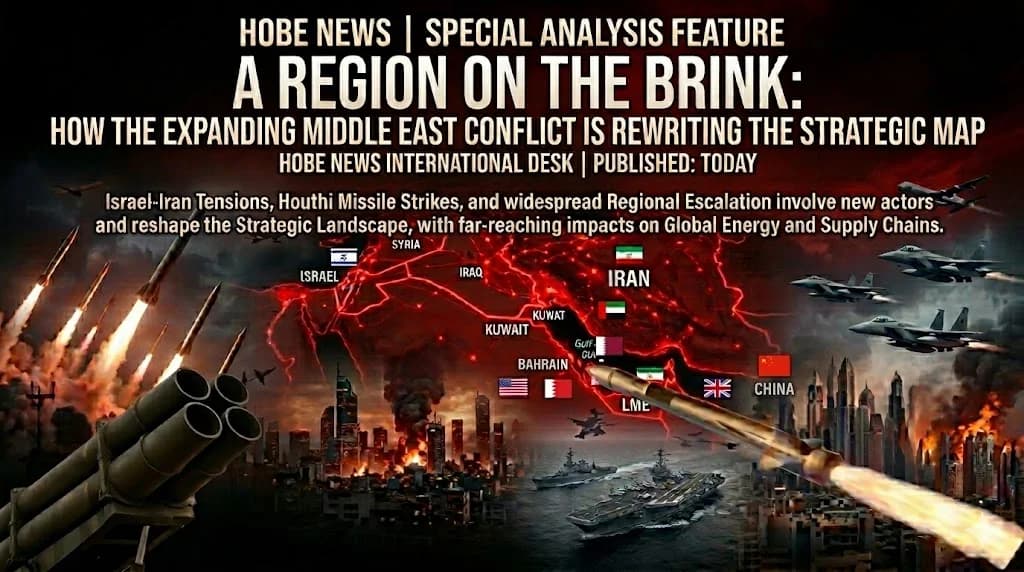
Report by Hobe News International Desk The Middle East is facing a sharp escalation in tensions as a widening conflict involving Israel and Iran draws in allied groups, raising concerns about a broader regional confrontation. What began as a series of exchanges between Israel and Iran has evolved into a more complex confrontation involving state and non-state actors. The situation intensified after Iran-aligned Houthi movement launched missiles toward Israel, prompting retaliatory strikes in Lebanon , according to Reuters . Escalation Across Multiple Fronts Analysts warn the conflict is no lon
Report by Hobe News International Desk
The Middle East is facing a sharp escalation in tensions as a widening conflict involving Israel and Iran draws in allied groups, raising concerns about a broader regional confrontation.
What began as a series of exchanges between Israel and Iran has evolved into a more complex confrontation involving state and non-state actors. The situation intensified after Iran-aligned Houthi movement launched missiles toward Israel, prompting retaliatory strikes in Lebanon, according to Reuters.
Escalation Across Multiple Fronts
Analysts warn the conflict is no longer confined to bilateral hostilities. Armed groups and regional allies are increasingly involved, creating overlapping fronts that heighten the risk of miscalculation, and the growing number of actors and unclear red lines could make the situation harder to contain.
The involvement of groups such as the Houthis underscores the expanding role of non-state actors, whose actions can rapidly shift the trajectory of the conflict.
U.S. Signals Restraint While Backing Israel
The United States has reaffirmed its support for Israel while urging de-escalation. The United States Department of State has emphasized the need to avoid a wider regional war.
However, Washington’s dual role, as a security partner and a diplomatic actor places it in a delicate position as tensions continue to rise.
Economic Concerns Grow
The conflict is also sending ripples through global markets. The Middle East’s central role in energy production has made investors wary, with oil prices rising amid fears of disruption to key shipping routes such as the Red Sea and the Persian Gulf.
Economists warn that prolonged instability could affect global supply chains and contribute to inflation, particularly in energy-dependent economies.
Mounting Humanitarian Impact
On the ground, humanitarian conditions are deteriorating. Civilians in Lebanon and Yemen face increasing risks as military operations intensify, while aid agencies report growing challenges in delivering essential supplies.
The United Nations has called for an immediate ceasefire, warning that continued escalation could worsen the humanitarian situation across the region. report of Hobe News International Desk



Comments
No comments yet. Be the first to share a thought.