
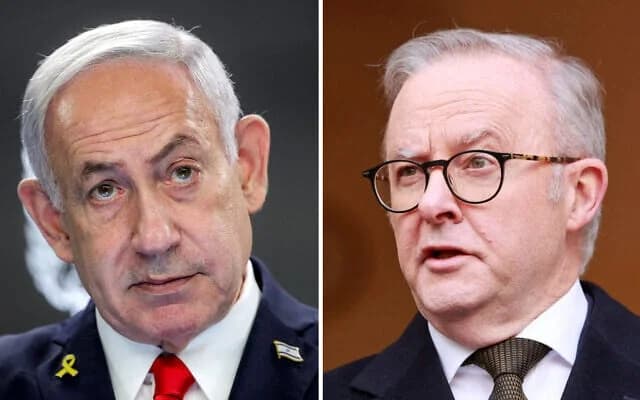
Israeli Prime Minister Benjamin Netanyahu has intensified his criticism of Australian Prime Minister Anthony Albanese, deepening the diplomatic rift between the two leaders. Netanyahu, who last week branded Albanese a “weak politician who betrayed Israel and abandoned Australia’s Jews” over Canberra’s shift on Palestinian statehood and its visa rejection of a far-right Israeli politician, renewed his attack in a rare interview with an Australian outlet. Speaking to Sky News Australia in an interview [later cited by 9News ] set to air tonight, Netanyahu accused Albanese of displaying weaknes
Israeli Prime Minister Benjamin Netanyahu has intensified his criticism of Australian Prime Minister Anthony Albanese, deepening the diplomatic rift between the two leaders. Netanyahu, who last week branded Albanese a “weak politician who betrayed Israel and abandoned Australia’s Jews” over Canberra’s shift on Palestinian statehood and its visa rejection of a far-right Israeli politician, renewed his attack in a rare interview with an Australian outlet. Speaking to
Sky News Australia
in an interview [later cited by
9News
] set to air tonight, Netanyahu accused Albanese of displaying weakness in the face of Hamas. “I’m sure he has a reputable record as a public servant, but I think his record is forever tarnished by the weakness that he showed in the face of these Hamas terrorist monsters,” Netanyahu said. “When the worst terrorist organisation on earth, these savages who murdered women, raped them, beheaded men, burnt babies alive in front of their parents, took hundreds of hostages, when these people congratulate the Prime Minister of Australia, you know something is wrong.” Albanese has not yet responded to Netanyahu’s latest comments, but the dispute has already strained ties between Canberra and Jerusalem.
Sanctions, Visa Bans, and Palestinian Statehood
The tensions stem from Australia’s decision to impose sanctions on two far-right Israeli politicians, as well as its pledge to support Palestinian statehood at the United Nations General Assembly in September. Australia joined the United Kingdom, Canada, and France in promising recognition, a move that Israel sharply opposed. Israeli Foreign Minister Gideon Sa’ar retaliated on Monday by revoking the visas of Australian representatives in Palestine. He also instructed Israel’s embassy in Canberra to “carefully examine” all future visa applications from Australians, following Canberra’s decision to deny entry to Religious Zionism Party lawmaker Simcha Rotman.
Also Read: Israel revokes Australian representatives’ visas amid tensions over Palestine recognition
Rotman’s party advocates for continuing the war on Gaza, relocating Palestinians en masse, and reestablishing Jewish settlements in the enclave. Australian Foreign Minister Penny Wong condemned Israel’s retaliation as an “unjustified reaction,” accusing Netanyahu’s government of “isolating Israel and undermining international efforts towards peace and a two-state solution.” The Israeli leader further escalated the confrontation in a sharply worded letter to Albanese, which was shared publicly by the Australian Jewish Association. In the letter cited by
9News
, dated August 17, Netanyahu warned that supporting Palestinian statehood “pours fuel on this antisemitic fire” and gave Albanese a deadline to reverse his position. “Prime Minister, antisemitism is a cancer. It spreads when leaders stay silent. It retracts when leaders act. I call upon you to replace weakness with action, appeasement with resolve, and to do so by a clear date: the Jewish New Year, September 23, 2025,” Netanyahu wrote. “History will not forgive hesitation. It will honour action.” On Tuesday, Netanyahu publicly escalated further, writing on X: “History will remember Albanese for what he is: A weak politician who betrayed Israel and abandoned Australia’s Jews.”
Also Read: Netanyahu calls Albanese “a weak politician who betrayed Israel, abandoned Australian Jews
Albanese brushed off the remarks, saying he would not engage personally. “I treat leaders of other countries with respect and I engage with them in a diplomatic way,” he told reporters. “I don’t take these things personally. He has had similar things to say about other leaders.” Home Affairs Minister Tony Burke defended the prime minister, telling the
ABC
: “Strength is not measured by how many people you can blow up, or how many children you can leave hungry.”



Comments
No comments yet. Be the first to share a thought.