
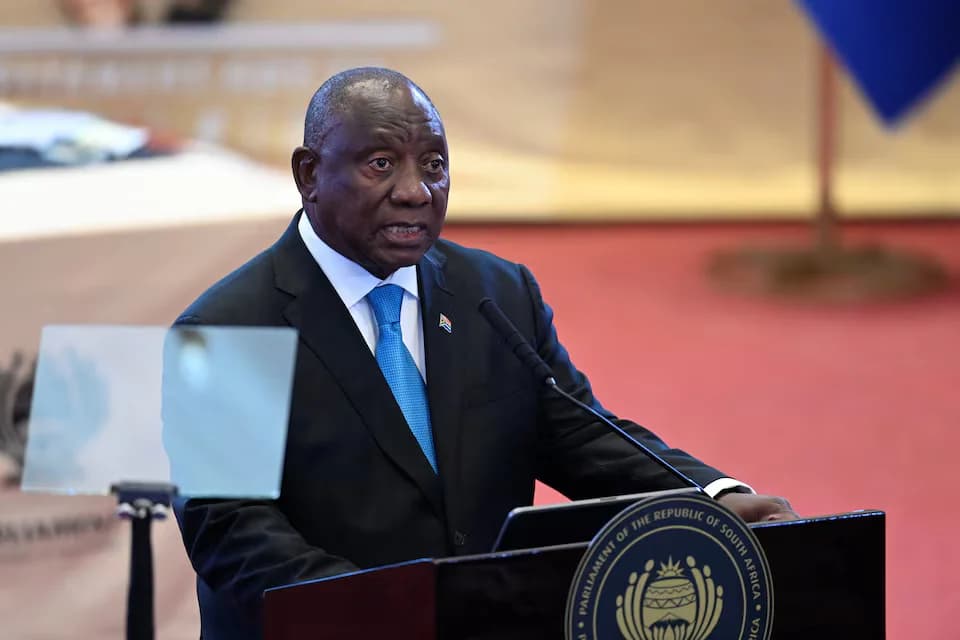
President Cyril Ramaphosa has said South Africa stands ready to help mediate in the escalating conflict in the Middle East, stressing that dialogue and a ceasefire are urgently needed to prevent further loss of life and regional destabilisation. Speaking on the sidelines of an energy conference in Cape Town , Ramaphosa told reporters that his country would be willing to step in should an opportunity for mediation arise. “ South Africa is always ready to play a contributing role, either in mediation or whatever. And if a gap opens or if we are asked, we always live up to our obligations ,” he s
President Cyril Ramaphosa has said South Africa stands ready to help mediate in the escalating conflict in the Middle East, stressing that dialogue and a ceasefire are urgently needed to prevent further loss of life and regional destabilisation.
Speaking on the sidelines of an energy conference in Cape Town, Ramaphosa told reporters that his country would be willing to step in should an opportunity for mediation arise. “South Africa is always ready to play a contributing role, either in mediation or whatever. And if a gap opens or if we are asked, we always live up to our obligations,” he said in remarks broadcast by Newzroom Afrika.
Ramaphosa emphasised that an immediate ceasefire should be the priority and that negotiations remain the only viable path toward ending the war. “Dialogue is always the best way of ending conflict and then ending the war. And we want this war to come to an end immediately,” he said.
South Africa has previously voiced concern about violations of international law linked to the conflict. In a recent statement, the presidency said that “anticipatory self-defence is not permitted under international law and self-defence cannot be based on assumption or anticipation,” signaling a firm stance on adherence to global legal norms, without directly naming any party to the conflict.
Pretoria’s offer to mediate comes against the backdrop of its longstanding diplomatic relationships with countries that have tense relations with the West, including Iran, Russia and Venezuela. South Africa’s ties with Moscow in particular date back to Soviet support for the anti-apartheid struggle led by the governing African National Congress.
Earlier this year, Iran participated in joint naval exercises in South African waters, a move that drew criticism from the United States Embassy in South Africa, which accused Pretoria of “cozying up” to Tehran. Ramaphosa later indicated that Iran’s participation had occurred against his instruction.
Despite such tensions, South Africa has consistently framed its foreign policy as one rooted in non-alignment, multilateralism and peaceful conflict resolution. The government has also highlighted the broader economic impact of the Middle East war on African countries, including disruptions to energy markets and supply chains.
South Africa has previously played mediating roles in African conflicts and has sought to position itself as a bridge between the Global South and Western powers. Its membership in multilateral groupings such as BRICS and its advocacy for reform of global institutions reflect ambitions to be seen as an influential diplomatic actor beyond the continent.
Whether its offer to mediate will be accepted by the parties involved remains uncertain. But Ramaphosa’s comments signal Pretoria’s intention to engage constructively in efforts to de-escalate one of the most volatile crises in recent history.
As the conflict intensifies, South Africa’s call for an immediate ceasefire underscores a broader international push for diplomacy over further military escalation.



Comments
No comments yet. Be the first to share a thought.