
The political landscape of the European Union (EU) has undergone a significant transformation following the recent elections for the European Parliament. The voting results across the 27-member bloc have revealed a pronounced shift to the right, reshaping the dynamics within the EU and causing ripples through the member states' governments. This change has placed mainstream political groups at a critical juncture, forcing them to reassess their strategies and policies in response to the electorate's new direction. A Victory for the Centre-Right Amidst this political shift, European Commiss
The political landscape of the European Union (EU) has undergone a significant transformation following the recent elections for the European Parliament. The voting results across the 27-member bloc have revealed a pronounced shift to the right, reshaping the dynamics within the EU and causing ripples through the member states' governments. This change has placed mainstream political groups at a critical juncture, forcing them to reassess their strategies and policies in response to the electorate's new direction.
A Victory for the Centre-Right
Amidst this political shift, European Commission President Ursula von der Leyen and her centre-right European People’s Party (EPP) have claimed a noteworthy victory. The EPP emerged from the elections retaining the most seats of any single group in the European Parliament. This success for the EPP underscores the broader rightward trend, reflecting growing support for conservative and right-leaning policies among European voters. President von der Leyen, in her victory speech, emphasized the need for stability and continuity, pledging to address the concerns of voters who feel left behind by rapid globalization and socio-economic changes. Her leadership will now be critical in navigating the EU through this period of political recalibration.
The Rise of Right-Wing and Populist Parties
The elections also marked significant gains for various right-wing and populist parties across the EU. These parties, which often adopt a critical stance toward EU policies on issues such as immigration, sovereignty, and economic regulation, have capitalized on public discontent and concerns about national identity and security. Countries such as Italy, Hungary, and Poland saw particularly strong performances by their right-wing parties. Italy's Lega party, led by Matteo Salvini, and Hungary's Fidesz party, headed by Viktor Orbán, both solidified their positions, reflecting a growing nationalist sentiment within their electorates. This surge presents both challenges and opportunities for the EU, as it strives to maintain cohesion and address the diverse priorities of its member states.
Mainstream Parties at a Crossroads
The election results have placed mainstream political groups, particularly those on the centre-left, at a crossroads. Traditional parties such as the Socialists and Democrats (S&D) and the Alliance of Liberals and Democrats for Europe (ALDE) have experienced a decline in support, prompting calls for introspection and renewal. These groups must now grapple with how to remain relevant and appealing to voters who are increasingly gravitating toward more polarized political options. For the S&D, the challenge lies in addressing the economic and social concerns of their traditional base while adapting to new political realities. Similarly, ALDE faces the task of positioning itself as a centrist force capable of bridging divides and fostering unity within the EU.
Implications for EU Policy and Governance
The rightward shift in the European Parliament is likely to have profound implications for EU policy and governance. Issues such as immigration control, economic regulation, and relations with external powers like Russia and China may see a reorientation reflecting the priorities of the strengthened right-wing factions. Immigration, in particular, is poised to become an even more contentious topic. With right-wing parties advocating for stricter controls and greater emphasis on national sovereignty, the EU's approach to migration and asylum policies will be a critical area of negotiation and potential conflict. Economic policy, too, may witness changes as the EPP and other right-leaning groups push for measures that favor deregulation and market-oriented reforms. This could lead to debates on balancing economic growth with social protections and environmental sustainability.

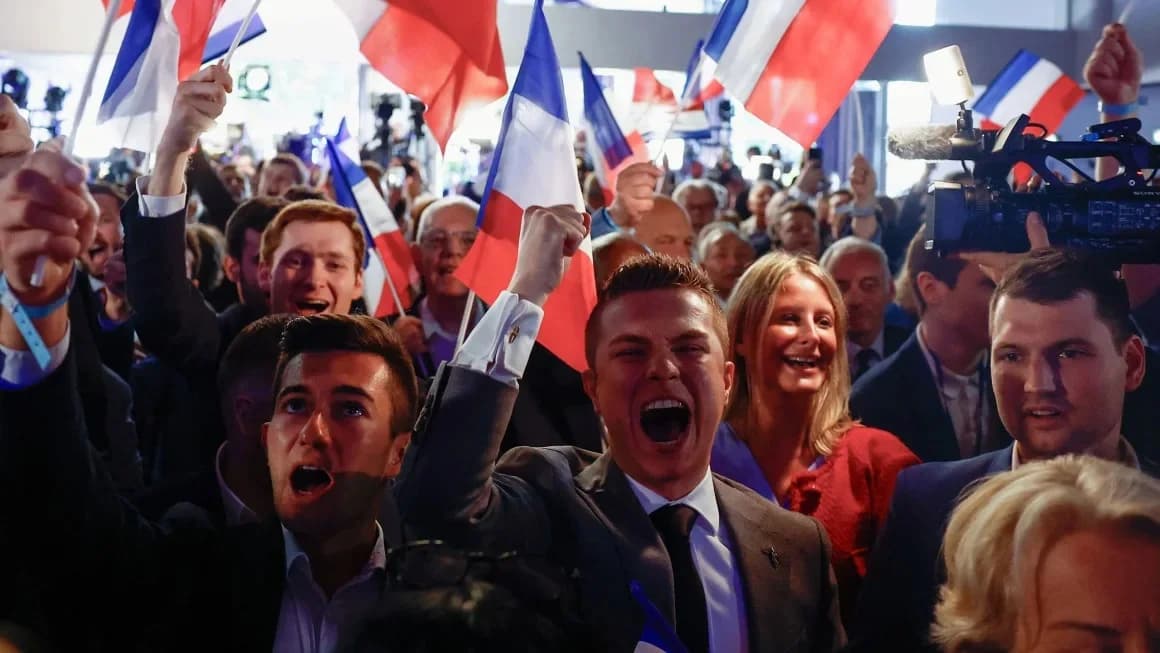
Supporters of the French far-right National Rally party in Paris after polls close for the European Parliament elections on June 9. ( photo by Reuters)



Comments
No comments yet. Be the first to share a thought.