
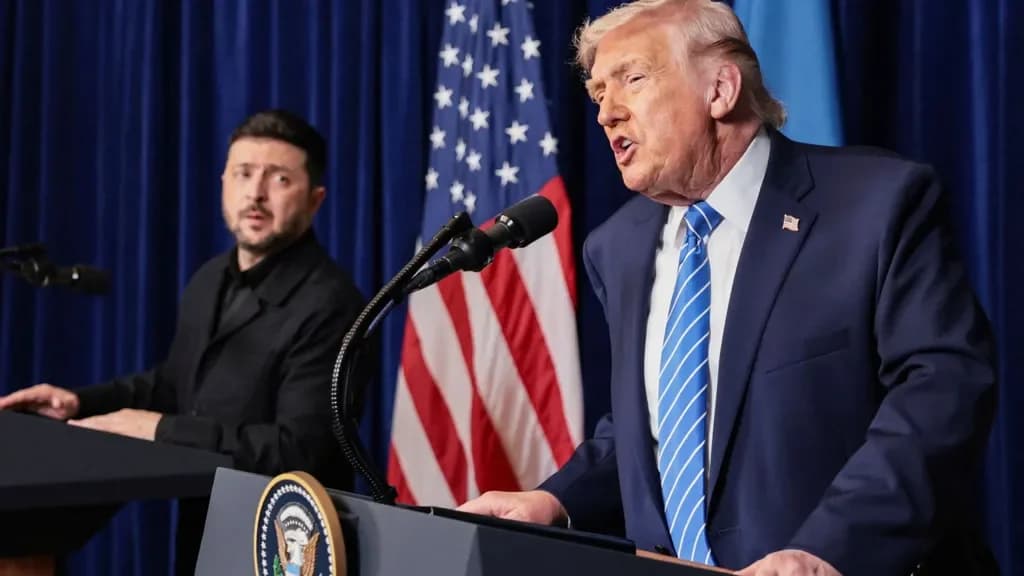
Talks aimed at ending Russia’s war in Ukraine made notable progress during a meeting between US President Donald Trump and Ukrainian President Volodymyr Zelensky in Florida, though key disagreements particularly over territory remain unresolved. Speaking after the meeting at Mar-a-Lago, both leaders described the discussions as productive. Zelensky said Ukraine and the United States had reached agreement on about 90% of a proposed 20-point peace plan, while Trump claimed that security guarantees for Ukraine were “close to 95% done.” Despite the optimistic tone, Trump acknowledged that “one o
Talks aimed at ending Russia’s war in Ukraine made notable progress during a meeting between US President Donald Trump and Ukrainian President Volodymyr Zelensky in Florida, though key disagreements particularly over territory remain unresolved. Speaking after the meeting at Mar-a-Lago, both leaders described the discussions as productive. Zelensky said Ukraine and the United States had reached agreement on about 90% of a proposed 20-point peace plan, while Trump claimed that security guarantees for Ukraine were “close to 95% done.” Despite the optimistic tone, Trump acknowledged that “one or two very thorny issues” were still blocking a final deal, with land and sovereignty at the center of the dispute. Territorial control remains the most sensitive issue. Russia currently occupies roughly 20% of Ukrainian territory after launching its full-scale invasion in February 2022. The Donbas region in eastern Ukraine — comprising Donetsk and Luhansk — is largely under Russian control, with Moscow holding about 75% of Donetsk and nearly all of Luhansk. Trump said proposals to turn Donbas into a demilitarized zone were still unresolved, noting that some land “has been taken” and that future developments on the ground could further complicate negotiations. Kyiv has resisted Russian demands that Ukraine fully withdraw from the remaining parts of Donbas under its control. Ukrainian officials have instead suggested the region could become a free economic zone, policed by Ukrainian forces, a proposal Moscow has so far rejected. Trump’s own stance on Ukraine’s territorial losses has shifted in recent months. In September, he suggested Ukraine might eventually regain occupied land, before later reversing that position. After the Florida talks, he described the land question as “very tough” but insisted it would ultimately be resolved. On security guarantees, Trump stopped short of formally committing US troops or logistical support to protect Ukraine from future attacks, despite saying negotiations on the issue were nearly complete. He also floated the idea of trilateral talks involving the United States, Russia, and Ukraine, saying such a meeting could take place “at the right time.” Earlier in the day, Trump held a phone call with Russian President Vladimir Putin. While offering few details, Trump said he believed Putin “wants Ukraine to succeed,” but also acknowledged Russia’s opposition to a ceasefire that would allow Ukraine to organize a referendum in contested territories. “I understand that position,” Trump said. Russia’s foreign policy adviser Yuri Ushakov confirmed the call was initiated by Trump and said the two leaders discussed recent peace proposals from the EU and Ukraine. According to Ushakov, both presidents agreed that a temporary ceasefire proposed by Europe and Kyiv could prolong the conflict rather than end it. Zelensky later confirmed that US and Ukrainian negotiating teams would meet again next week to address remaining obstacles. He also suggested that further high-level talks could take place at the White House in January, potentially involving European leaders. European allies cautiously welcomed the progress. European Commission President Ursula von der Leyen praised the talks but stressed that Ukraine must receive “ironclad security guarantees from day one.” French President Emmanuel Macron announced that countries from the so-called “Coalition of the Willing” would meet in Paris early next month to finalize their concrete contributions to Ukraine’s future security. While Trump has repeatedly expressed a desire to bring the Ukraine-Russia war to an end, he warned that negotiations could still fail. If talks were to stall or collapse, he said, the conflict could continue underscoring how fragile the path to peace remains, despite recent momentum.



Comments
No comments yet. Be the first to share a thought.