
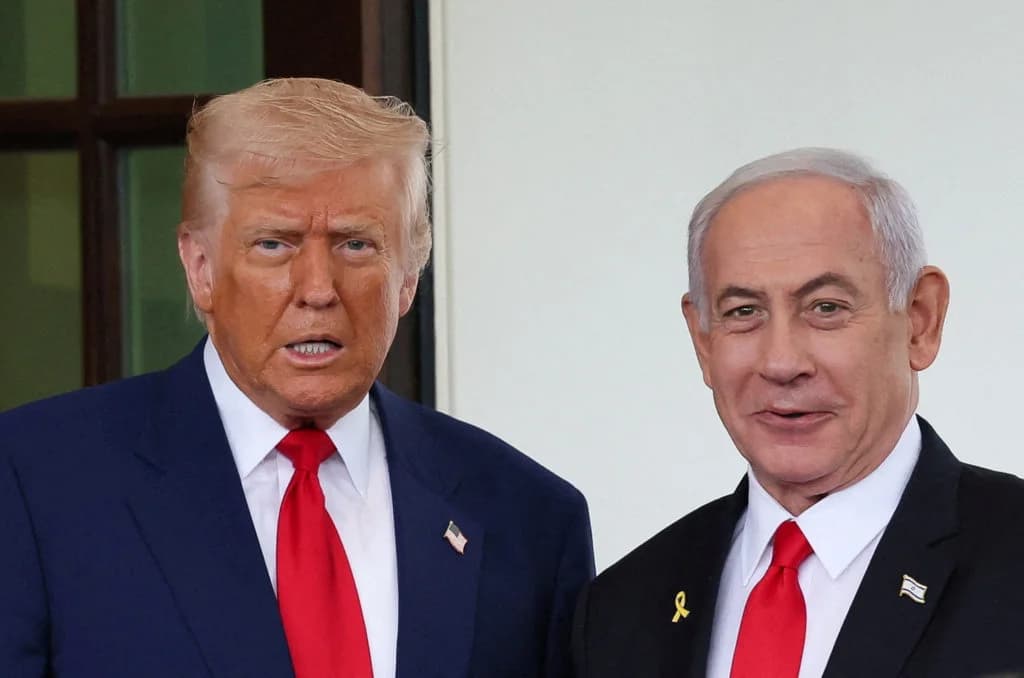
U.S. President Donald Trump has said he hopes to move “very quickly” into the second phase of the Gaza ceasefire agreement, warning that Hamas would face severe consequences if it fails to disarm within a short period. Trump made the remarks on Monday after talks with Israeli Prime Minister Benjamin Netanyahu in Florida, where the two leaders discussed the implementation of the U.S.-backed, 20-point Gaza peace plan. Central to the framework is the requirement that Hamas disarm as a condition for advancing to the next phase. “As quickly as we can. But there has to be disarmament,” Trump said wh
U.S. President Donald Trump has said he hopes to move “very quickly” into the second phase of the Gaza ceasefire agreement, warning that Hamas would face severe consequences if it fails to disarm within a short period.
Trump made the remarks on Monday after talks with Israeli Prime Minister Benjamin Netanyahu in Florida, where the two leaders discussed the implementation of the U.S.-backed, 20-point Gaza peace plan. Central to the framework is the requirement that Hamas disarm as a condition for advancing to the next phase.
“As quickly as we can. But there has to be disarmament,” Trump said when asked how soon phase two could begin. Referring to Hamas, he added: “If they don’t disarm as they agreed to do, there will be hell to pay for them.”
Trump insisted that Israel had fulfilled its obligations under the ceasefire. “Israel has lived up to the plan 100%,” he said, dismissing concerns that Tel Aviv was dragging its feet on implementation.
According to Reuters, the ceasefire, which came into effect in October, outlines a second phase that would see the establishment of a technocratic government in Gaza, the withdrawal of Israeli troops, the disarmament of Hamas, and the start of large-scale reconstruction in the war-ravaged enclave. Trump said rebuilding efforts could “begin pretty soon.”
However, critics argue that Netanyahu may seek to delay the transition by pressing for Hamas’s full disarmament before any Israeli military withdrawal. The Israeli leader has also faced accusations of avoiding meaningful engagement on the long-term political future of Palestinians. Hamas officials have countered that full disarmament should occur alongside concrete steps toward an independent Palestinian state.
Since the ceasefire took effect, at least 414 Palestinians have been killed by Israeli military actions in Gaza, according to the Hamas-run health ministry. Israel’s military says it has only fired in response to ceasefire violations and has blamed Hamas for the killing of three Israeli soldiers during the same period.
Beyond Gaza, Trump also issued a strong warning to Iran, saying the United States could support further military strikes if Tehran resumes rebuilding its ballistic missile or nuclear weapons programs. He claimed to have seen reports suggesting Iran might be using alternative sites after previous U.S. strikes.
“I hope they’re not trying to build up again, because if they are, we’re going to have no choice but to eradicate that build-up,” Trump said. Iran has repeatedly denied seeking nuclear weapons.
In response, Ali Shamkhani, a top political adviser to Iran’s supreme leader, said on X that any aggression against Iran would be met with an “immediate harsh response.” Iranian officials described reports of renewed nuclear activity as a “psychological operation” and warned that further attacks would lead to harsher consequences for Israel.
Trump and Netanyahu also discussed wider regional tensions, including Syria and the Hezbollah militant group in Lebanon. Netanyahu said Israel wants a peaceful border with Syria, while Trump expressed cautious optimism about Syria’s new president, Ahmed al-Sharaa, who took power after the overthrow of Bashar al-Assad last year.
Trump noted that while Syria’s new leader has a hardline past, stability often requires tough leadership. “You’re not going to get a choir boy to lead Syria,” he said.
The discussions come months after Trump signed an executive order in June ending U.S. sanctions on Syria, signaling a shift in U.S. regional policy amid continuing instability across the Middle East.



Comments
No comments yet. Be the first to share a thought.