
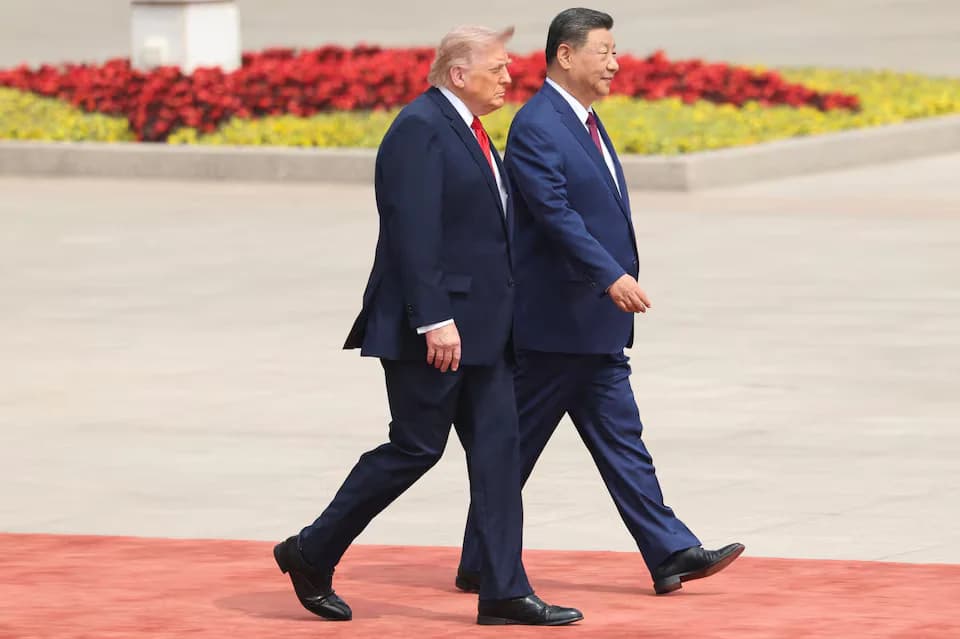
Donald Trump arrived in Beijing with one issue overshadowing everything else: Iran. In talks with Xi Jinping, both leaders agreed the Strait of Hormuz must remain open and that Iran should never obtain nuclear weapons. Beyond that, however, there was little sign of a breakthrough. Washington hopes China, the largest buyer of Iranian oil and one of the few powers with meaningful leverage over Tehran, can pressure Iran into easing tensions in the Gulf. Beijing’s public response remained cautious, with U.S. Treasury Secretary Scott Bessent saying only that China would “do what they can” to help
Donald Trump arrived in Beijing with one issue overshadowing everything else: Iran. In talks with Xi Jinping, both leaders agreed the Strait of Hormuz must remain open and that Iran should never obtain nuclear weapons. Beyond that, however, there was little sign of a breakthrough. Washington hopes China, the largest buyer of Iranian oil and one of the few powers with meaningful leverage over Tehran, can pressure Iran into easing tensions in the Gulf. Beijing’s public response remained cautious, with U.S. Treasury Secretary Scott Bessent saying only that China would “do what they can” to help keep the shipping route open. Meanwhile, the situation around the strait continues to deteriorate. An Indian cargo vessel carrying livestock from Africa to the United Arab Emirates was sunk Thursday off the coast of Oman in what maritime security advisers said appeared to be a missile or drone strike. All 14 crew members were rescued by Omani authorities. Separately, a vessel anchored near the Emirati port of Fujairah was boarded by unidentified personnel and redirected toward Iranian waters, according to British maritime monitors. The incident heightened concerns over the security of a corridor that is strategically vital because Fujairah serves as the UAE’s only major oil export terminal located outside the strait itself. The confrontation has now settled into a costly stalemate. After six weeks of U.S. and Israeli strikes on Iranian targets, military operations were paused more than a month ago amid expectations that diplomacy could produce a settlement. That progress has not materialized. Iran still possesses more than 400 kilograms of highly enriched uranium near weapons-grade levels, retains missile and drone capabilities demonstrated throughout the conflict, and has shown it can significantly disrupt shipping through one of the world’s most important energy chokepoints. Washington wants Tehran to surrender its enriched uranium stockpile and halt future enrichment activity. Iran, meanwhile, is demanding sanctions relief, compensation for war damage and recognition of expanded authority over Gulf shipping routes. Neither side has shown willingness to abandon positions the other considers unacceptable. Even so, Tehran appears to be selectively allowing some traffic through the strait after direct engagement with foreign governments. Japanese and Chinese tankers crossed this week following separate diplomatic contacts with Iran. Iranian officials said 30 vessels had passed through the waterway since Wednesday evening, well below the roughly 140 daily crossings seen before the conflict, but enough to suggest Iran is calibrating access rather than enforcing a complete closure. When the conflict began, Trump said the objective was to dismantle Iran’s nuclear program, curb its ability to threaten neighboring states and create conditions for internal political change. More than two months later, none of those goals appear fully achieved, while Iran has gained additional leverage through its demonstrated capacity to disrupt maritime trade in the Gulf. Source: Reuters



Comments
No comments yet. Be the first to share a thought.