
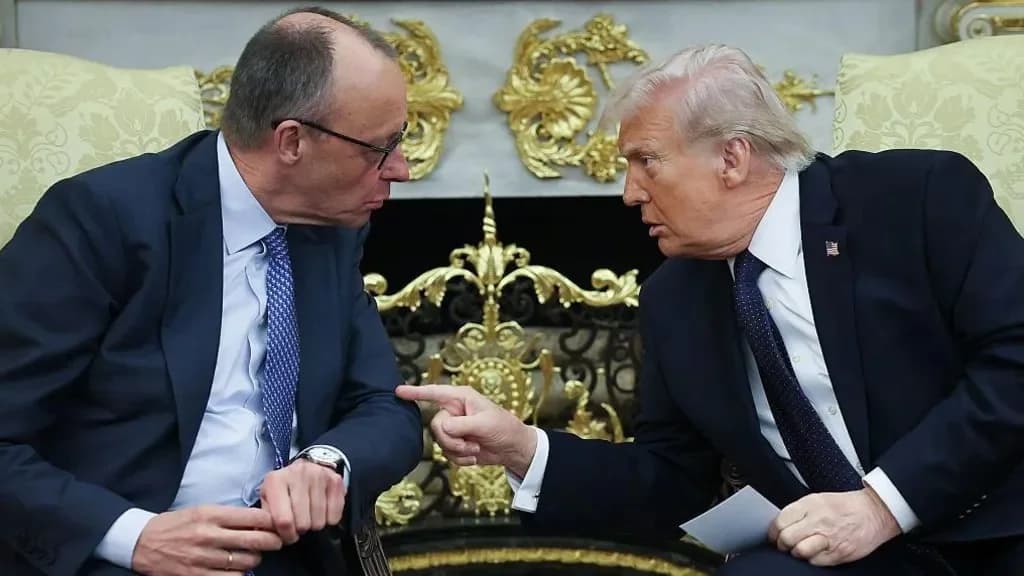
The United States has announced plans to withdraw 5,000 troops from Germany, a move that signals growing tensions between Washington and Berlin amid disagreements over the Iran conflict and broader security strategy. According to the Pentagon, the decision follows a strategic review ordered by Defence Secretary Pete Hegseth. The withdrawal, expected to be completed within six to twelve months, reflects what officials described as “theatre requirements and conditions on the ground.” However, the timing has drawn attention, coming just days after a sharp public exchange between US President Don
The United States has announced plans to withdraw 5,000 troops from Germany, a move that signals growing tensions between Washington and Berlin amid disagreements over the Iran conflict and broader security strategy. According to the Pentagon, the decision follows a strategic review ordered by Defence Secretary Pete Hegseth. The withdrawal, expected to be completed within six to twelve months, reflects what officials described as “theatre requirements and conditions on the ground.” However, the timing has drawn attention, coming just days after a sharp public exchange between US President Donald Trump and German Chancellor Friedrich Merz. Political tensions spill into military decisions The dispute escalated after Merz criticised US handling of negotiations with Iran, suggesting Washington had been “humiliated” diplomatically. He argued that the United States lacks a clear strategy and questioned its long-term approach to the crisis. Trump responded forcefully on social media, attacking Merz’s leadership and accusing him of incompetence on key domestic and foreign policy issues. He further claimed that Germany’s economic struggles reflect weak governance, intensifying an already strained transatlantic relationship. The disagreement also extends to NATO cooperation and military commitments. Trump has repeatedly criticised European allies for failing to support US-led operations, particularly efforts to secure the Strait of Hormuz amid rising tensions with Iran. He has even hinted at reducing troop deployments in other European countries, including Italy and Spain, accusing them of not contributing enough to joint security efforts. Strategic importance of Germany Germany hosts the largest US military presence in Europe, with over 36,000 active-duty personnel stationed across the country. Key facilities such as Ramstein Air Base serve as critical hubs for US and NATO operations. German Defence Minister Boris Pistorius acknowledged the importance of American troops in Europe, stating that their presence benefits both nations. However, he also admitted that a reduction was “foreseeable,” suggesting Berlin had anticipated a shift in US military posture. Despite past tensions over defence spending, Germany has significantly increased its military budget in recent years. Projections indicate defence expenditure will reach 3.1% of GDP by next year, surpassing NATO’s 2% target—a longstanding demand from Washington. Broader geopolitical shift The troop withdrawal aligns with a broader US strategy to rebalance its global military focus. Recent decisions, including reductions in Romania, reflect a pivot away from Europe toward the Indo-Pacific region, where Washington sees growing strategic competition. Still, the move has sparked concern among US lawmakers and Eastern European allies, particularly those wary of Russian influence. Previous attempts to reduce troop levels in Germany during Trump’s earlier administration were blocked by Congress, highlighting the sensitivity of such decisions. Uncertain future for transatlantic ties As tensions between Trump and Merz continue to unfold, the planned withdrawal raises questions about the future of US-European relations. While framed as a strategic adjustment, the decision underscores deeper political fractures that could reshape NATO dynamics and Western security cooperation. With Europe facing evolving security challenges, the coming months will reveal whether this move is a temporary recalibration or the beginning of a more significant shift in US foreign policy.



Comments
No comments yet. Be the first to share a thought.