

Yemen’s internationally recognised government has announced a major military offensive aimed at pushing back Houthi forces and eventually retaking the capital, Sanaa, marking a significant shift in the country’s long-running war. The Saudi-backed Yemeni forces said on Monday, October 5, that they had launched what they described as a “strategic offensive”, beginning with operations around the Bab al-Mandeb Strait and the western parts of Taiz governorate. The government said its forces had recaptured Dhubab district and several strategic positions near the Red Sea coast following clashes wit
Yemen’s internationally recognised government has announced a major military offensive aimed at pushing back Houthi forces and eventually retaking the capital, Sanaa, marking a significant shift in the country’s long-running war. The Saudi-backed Yemeni forces said on Monday, October 5, that they had launched what they described as a “strategic offensive”, beginning with operations around the Bab al-Mandeb Strait and the western parts of Taiz governorate. The government said its forces had recaptured Dhubab district and several strategic positions near the Red Sea coast following clashes with the Houthis, also known as Ansar Allah. Yemeni Assistant Defence Minister Major-General Samir Al-Sabri said the first phase of the operation would focus on securing the Bab al-Mandeb Strait and the port city of Mocha before expanding the campaign. “We seek to restore state authority across all Yemeni governorates,” Al-Sabri told Al Jazeera, saying the government intended to accelerate its military efforts. The offensive comes as Houthi forces have been advancing towards the outskirts of Taiz, one of Yemen’s most strategically important cities. Taiz itself remains under the control of government forces but has been surrounded by Houthi fighters for more than a decade. Recent fighting has also disrupted a strategic road connecting Taiz with Aden, the seat of Yemen’s Saudi-backed Presidential Leadership Council. Residents of Taiz have vowed to resist any attempt by the Houthis to capture the city, with some describing the fighting as a prolonged war of attrition. Analysts say the latest operation could represent one of the most significant changes in Yemen’s battlefield dynamics in years. Defence analyst Ibrahim Jalal said the Yemeni government had moved from a largely defensive strategy to an offensive one for the first time since 2018. For months, Houthi forces had largely controlled the timing and location of major confrontations. The new strategy seeks to force them to fight simultaneously across several fronts, potentially stretching their military capabilities. However, analysts caution that it is still too early to determine whether the offensive will produce a decisive breakthrough. The Houthis have previously used Yemen’s mountainous terrain to their advantage, and reports from the battlefield indicate that some fighters are moving away from exposed positions towards difficult-to-access areas as government forces advance along the Red Sea coast. The offensive is also unfolding amid heightened tensions between the Houthis and Saudi Arabia. US Secretary of State Marco Rubio said Saudi Arabia had the right to defend itself against Houthi attacks, while reaffirming Washington’s security commitments to Riyadh. The Houthis have increasingly relied on drones and other long-range weapons in attacks against Saudi territory, adding a regional dimension to Yemen’s internal conflict. The developments also come as regional countries discuss closer military coordination under the Mecca Joint Defence Agreement, with Houthi attacks on Saudi Arabia emerging as one of the factors driving the discussions. The immediate objective of the Yemeni government appears to be consolidating control along the western Red Sea coast, particularly around Bab al-Mandeb and Mocha, while preventing further Houthi advances around Taiz. Retaking Sanaa, however, would be a much larger and more difficult military undertaking. The capital has been under Houthi control since 2014, and the group maintains significant military capabilities and networks across northern Yemen. For now, the battlefield is entering a potentially new phase, with government forces attempting to seize the initiative after years of largely defensive warfare. Whether the offensive can translate into sustained territorial gains or trigger a wider escalation involving regional powers remains one of the key questions facing Yemen in the days ahead.
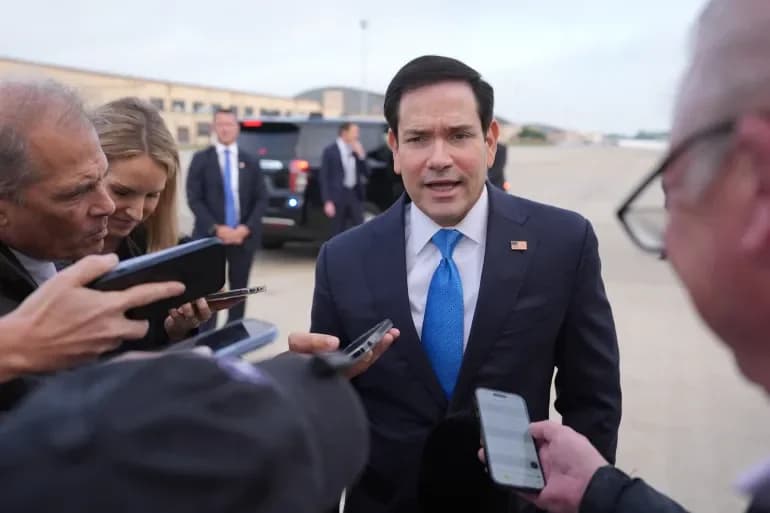
US Secretary of State Marco Rubio speaks to the press before departing Joint Base Andrews, Maryland, for Iceland on October 5, 2026.
Rubio was also responding to questions on the escalating situation involving Yemen and Saudi Arabia.


Comments
No comments yet. Be the first to share a thought.