
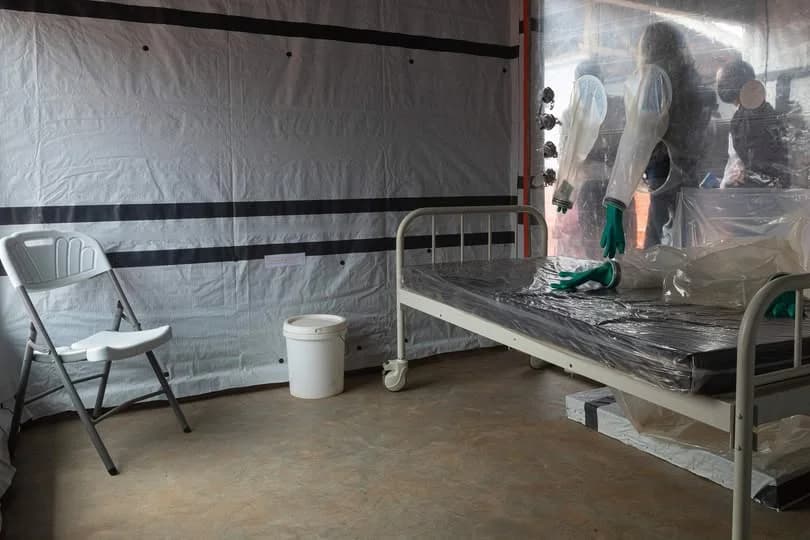
Uganda has confirmed an imported Ebola case after a Congolese man who crossed the border died at a hospital in Kampala on Friday, as the Democratic Republic of Congo battles an outbreak in Ituri province that has killed at least 80 people. Uganda's Health Ministry said the deceased man tested positive for Ebola after travelling from eastern Congo, and that no local transmission has been confirmed inside Uganda. The Africa Centers for Disease Control and Prevention reported approximately 246 suspected cases and 65 deaths as of 15 May, with the worst-affected areas concentrated in the Mongwalu a
Uganda has confirmed an imported Ebola case after a Congolese man who crossed the border died at a hospital in Kampala on Friday, as the Democratic Republic of Congo battles an outbreak in Ituri province that has killed at least 80 people.
Uganda's Health Ministry said the deceased man tested positive for Ebola after travelling from eastern Congo, and that no local transmission has been confirmed inside Uganda.
The Africa Centers for Disease Control and Prevention reported approximately 246 suspected cases and 65 deaths as of 15 May, with the worst-affected areas concentrated in the Mongwalu and Rwampara health zones of Ituri province. Suspected cases have also been reported in Bunia, the provincial capital, pending laboratory confirmation.
Preliminary results from Congo's Institut National de Recherche Biomédicale detected Ebola virus in 13 of 20 samples tested, with sequencing ongoing to confirm the exact strain.
Africa CDC flagged the urban density of Bunia and Rwampara, heavy population movement, mining-related mobility in Mongwalu, active armed insecurity, and proximity to the Ugandan and South Sudanese borders as factors raising the risk of further spread.
"Given the high population movement between affected areas and neighboring countries, rapid regional coordination is essential," said Dr Jean Kaseya, Director General of Africa CDC, in a statement issued Thursday. "We are working with DRC, Uganda, South Sudan and partners to strengthen surveillance, preparedness and response, and to help contain the outbreak as quickly as possible."
Uganda has previously contained Ebola incursions through rapid contact tracing and border surveillance, including during the 2022 Sudan strain outbreak, which was declared over after 55 days following aggressive isolation measures and community engagement.
Africa CDC convened an emergency high-level coordination meeting on Thursday with health authorities from Congo, Uganda and South Sudan, alongside the World Health Organization, UNICEF, and public health partners, focusing on cross-border surveillance, laboratory support, infection prevention and contact tracing.
The agency said it would assess the availability of medical countermeasures once sequencing results confirm the specific ebolavirus species.
Comments
No comments yet. Be the first to share a thought.