
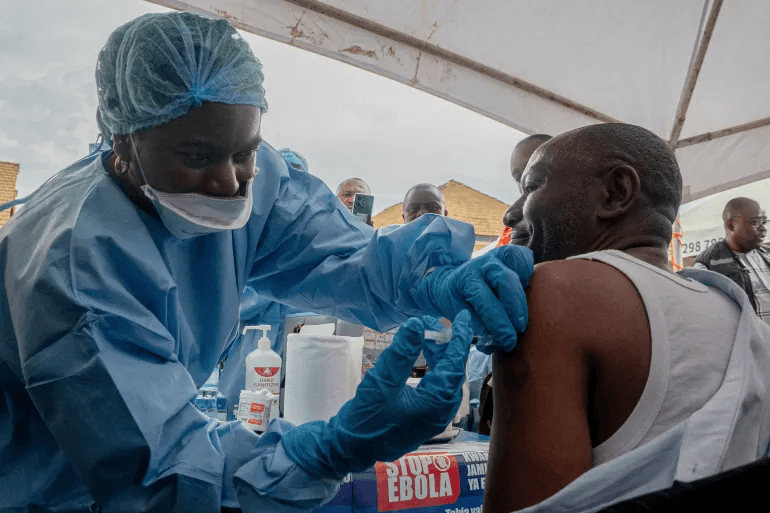
The World Health Organization has condemned an attack in eastern Democratic Republic of the Congo that killed a nurse and seriously injured another health worker, warning that violence and misinformation are undermining efforts to contain the Ebola outbreak.
A nurse has been killed and another health worker seriously injured after an attack on a team responding to an Ebola alert in the Democratic Republic of the Congo (DRC), according to the World Health Organization (WHO).
The incident occurred on Saturday in Bafwasende, in the eastern province of Tshopo. WHO Director-General Tedros Adhanom Ghebreyesus condemned the attack in a statement published on X on Sunday, calling for the protection of healthcare workers responding to the outbreak.
“Everyone working to protect communities from this deadly disease must be able to work in dignity and safety. Healthcare must always be protected,” Tedros said.
The WHO Regional Director for Africa, Dr Mohamed Yakub Janabi, also denounced the violence, warning that misinformation and fear must not lead to attacks on medical teams.
The attack comes as health authorities face growing challenges in containing an outbreak that has caused thousands of infections and deaths. According to data from the DRC’s Ministry of Health cited in the report, more than 9,800 cases and over 4,700 deaths had been recorded since the outbreak began in May, making it the deadliest Ebola outbreak in the country’s history.
Misinformation and distrust hamper response
Health workers have faced resistance from some communities, where scepticism about the disease and distrust of the government’s response have complicated efforts to control its spread.
In some areas, responders have reportedly been threatened or held captive while carrying out their duties. Previous incidents have also included attacks on health facilities and violence against individuals publicly supporting Ebola prevention measures.
Last month, a politician in North Kivu was beaten to death after defending the government’s response to the outbreak and urging people to follow preventive measures, including handwashing and social distancing.
Such incidents threaten the work of medical teams, particularly in remote communities where healthcare staff and medical supplies are already limited.
Ebola concerns spread beyond DRC
The outbreak has also raised concerns across national borders. Uganda announced on Sunday that citizens returning from the DRC with a history of travel to the affected country would be quarantined for 21 days.
Although Uganda declared an end to its latest Ebola outbreak in July, health officials remain alert after people who had recently travelled through the country later tested positive in Kenya and Nigeria.
Ebola spreads through direct contact with the bodily fluids of an infected person. Symptoms can take up to 21 days to appear.
The current outbreak is caused by the Bundibugyo strain, for which there is no approved vaccine or specific treatment, according to the report.
The WHO has called for stronger cross-border surveillance and cooperation while advising against travel or trade restrictions on affected countries.
As the response continues, the safety of healthcare workers remains critical to reaching affected communities, identifying infections and preventing further transmission.
Comments
No comments yet. Be the first to share a thought.