
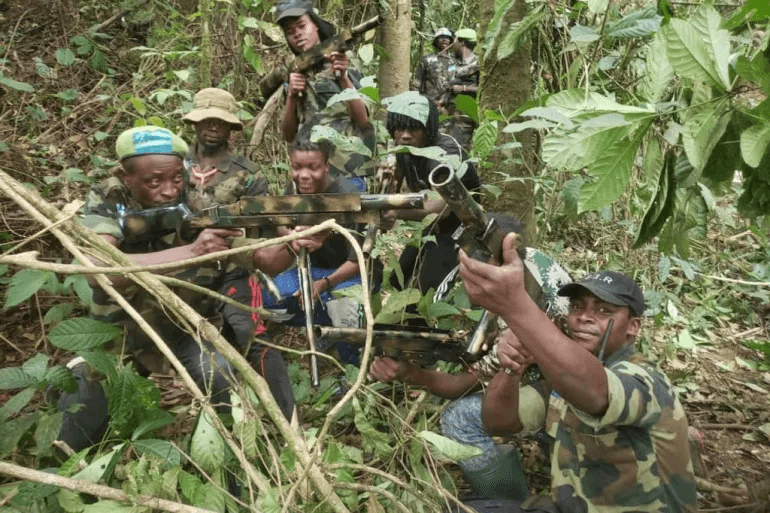
Former separatist fighters in Cameroon are facing uncertainty and difficult living conditions after abandoning the armed struggle, with many fearing arrest while others accuse the government’s reintegration programme of failing to deliver the support they were promised.
The former fighters were involved in a decade-long conflict in the country’s English-speaking Northwest and Southwest regions, where separatist groups have been fighting government forces in a campaign for independence.
Collins Mbah, formerly known as Commander No Sorrow, says he fought government forces between 2016 and 2020 and killed several soldiers. Today, he lives in the coastal city of Douala, where he works as a traditional healer.
Mbah says he abandoned the rebellion after witnessing fellow fighters turn against the civilians they had initially promised to protect. However, he has refused to join the government’s Disarmament, Demobilisation and Reintegration (DDR) programme, saying he wants no further involvement with either the authorities or armed groups.
“All I need now is peace of mind,” he told Al Jazeera.
His experience reflects the challenges facing other former fighters who have chosen to rebuild their lives independently rather than surrender through government-run rehabilitation centres.
Peter Mosongo, another former fighter, now works as a motorcycle taxi rider in Buea after leaving the rebellion in 2019. He says he quit after witnessing fellow fighters kill civilians indiscriminately.
Mosongo avoided the DDR programme because he feared imprisonment. He also said former colleagues threatened him and kidnapped his father in an attempt to force him to reveal his whereabouts.
Concerns over government reintegration programme
For those who joined the DDR programme, the experience has not always met expectations.
Paul Mukete, formerly known as King of Vultures, entered a rehabilitation centre in Tiko in 2020. Six years later, he says the programme has provided limited assistance, mainly training in poultry and pig farming, without the psychological support needed to rebuild his life.
Mental health specialist Fonbeh Hedwick Chia argues that former fighters and civilians have experienced serious psychological trauma and need long-term professional support.
Cameroon's Anglophone crisis began in 2016 following protests by lawyers and teachers against what they described as the marginalisation of English-speaking communities. The demonstrations eventually escalated into an armed separatist movement.
The conflict has killed thousands, displaced hundreds of thousands and disrupted education across the affected regions.
Political scientist Chris Roberts argues that the crisis goes beyond language differences, pointing to decades of poor governance and political challenges.
He maintains that a military solution alone cannot end the conflict, stressing the need for political reforms and meaningful dialogue.
The experiences of former fighters highlight a major challenge for Cameroon: ending the rebellion requires not only persuading combatants to surrender their weapons but also providing lasting support to help them return to civilian life.
Comments
No comments yet. Be the first to share a thought.