
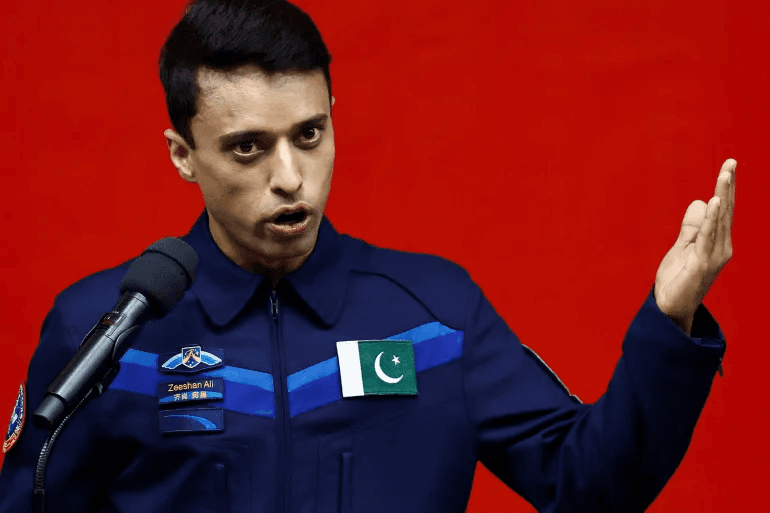
Pakistan is preparing to make history by sending its first astronaut into space, with Air Force pilot Muhammad Zeeshan Ali scheduled to join China’s Shenzhou-24 mission to the Tiangong space station on Wednesday, November 25, 2026.
Ali, 40, will travel alongside Chinese astronauts Tang Hongbo, who will serve as mission commander, and Wu Yi, a flight engineer. The spacecraft is scheduled to launch from the Jiuquan Satellite Launch Center in northwest China at 8:18 a.m. Beijing time.
According to the China Manned Space Agency (CMSA), the mission marks the first time a foreign astronaut will participate in China's crewed space programme.
Speaking at a news conference ahead of the launch on Tuesday, Ali described the mission as a historic responsibility, saying he was carrying the hopes of millions of Pakistanis.
“I want to assure you that I am not flying for myself. I carry the name of Pakistan on my shoulder, the hopes of 250 million Pakistanis,” he said.
Ali is expected to spend approximately one week aboard the Tiangong space station, where he will participate in scientific activities alongside the Chinese crew before returning to Earth aboard the Shenzhou-23 spacecraft.
Scientific research and cooperation
During his stay in orbit, Ali will mainly focus on joint scientific experiments between Pakistan and China, particularly in biotechnology and materials science.
The mission includes four research projects involving materials science, fluid physics, life sciences and biotechnology. One of the experiments will examine cyanobacteria, photosynthetic microorganisms with potential applications in scientific and industrial research.
Pakistan's Space and Upper Atmosphere Research Commission (SUPARCO) said the experiments could contribute to research addressing climate resilience, food security and industrial innovation.
According to SUPARCO, Ali's initial responsibility will include installing experimental equipment, preparing research samples and collecting data to assess how the equipment performs under microgravity conditions.
The experiments are expected to continue for between six and 12 months, extending the scientific value of the mission beyond Ali's brief stay in space.
A milestone in Pakistan-China relations
Ali was selected alongside another Pakistan Air Force pilot, Khurram Daud, through a three-stage recruitment process involving medical, psychological and technical assessments.
Both were named reserve astronauts by China's space agency in April 2026 before beginning specialised training at the Astronaut Center of China in Beijing.
Their preparation included centrifuge exercises, emergency procedures, survival training, flight simulations and learning technical Chinese, which is essential for operating the spacecraft and communicating with the Chinese crew.
Pakistan's Planning Minister Ahsan Iqbal praised both pilots for their performance during training, noting that although Ali had been selected for the mission, both had contributed to the historic achievement.
Speaking ahead of the launch, Ali also acknowledged the support of the Chinese and Pakistani space agencies, describing their cooperation as a major achievement.
“The two great nations of China and Pakistan have turned a pilot into an astronaut in a remarkably short span of time,” he said.
The mission follows an agreement signed between SUPARCO and CMSA in February 2025, strengthening cooperation between the two countries in human spaceflight and scientific research.
Beyond its symbolic importance, Ali's journey represents a significant step in Pakistan's participation in international space exploration, while highlighting China's growing role in providing opportunities for international cooperation through its Tiangong space station.

Comments
No comments yet. Be the first to share a thought.