
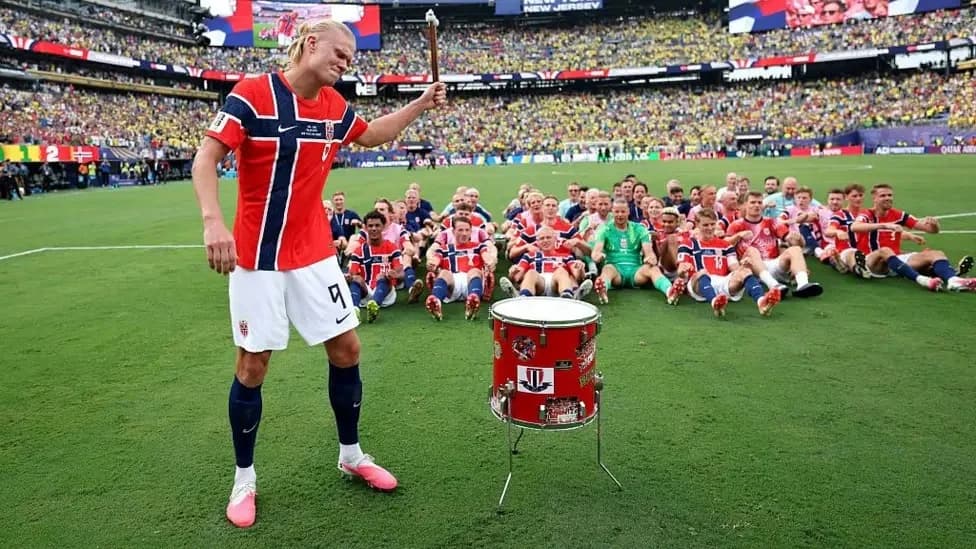
Norway's impressive rise at the 2026 FIFA World Cup is the result of decades of strategic planning, investment in infrastructure and a nationwide commitment to youth development, rather than the brilliance of one individual. Although Manchester City striker Erling Haaland has grabbed the headlines with seven goals at the tournament and Arsenal captain Martin Ødegaard continues to inspire the team, Norway's success reflects the strength of a football development system that has been carefully built over the past two decades. Seventeen of the country's 26 World Cup squad members currently play
Norway's impressive rise at the 2026 FIFA World Cup is the result of decades of strategic planning, investment in infrastructure and a nationwide commitment to youth development, rather than the brilliance of one individual. Although Manchester City striker Erling Haaland has grabbed the headlines with seven goals at the tournament and Arsenal captain Martin Ødegaard continues to inspire the team, Norway's success reflects the strength of a football development system that has been carefully built over the past two decades. Seventeen of the country's 26 World Cup squad members currently play in Europe's top four leagues—the Premier League, La Liga, Bundesliga and Serie A—highlighting the quality of talent being produced. A key factor behind Norway's transformation has been its investment in artificial pitches. Between 2016 and 2025, the country built 539 new artificial surfaces and renovated another 586, allowing football to be played throughout the year despite its long and harsh winters. The improved facilities have helped players develop stronger technical abilities and contributed to a shift away from the physical, direct style that once defined Norwegian football. The establishment of the National Team School (NTS) in 2013 also marked a turning point. Created after Norway failed to qualify for UEFA Euro 2012, the program connects grassroots clubs, regional football associations, professional clubs and the Norwegian Football Federation within a single player-development structure. Unlike centralized academies, the NTS ensures that every level of Norwegian football works together to identify and develop young talent. The impact of the system is evident in the current national team. Fourteen of the 15 players who featured in Norway's 2-1 World Cup victory over Brazil had represented the country at youth level, while 11 progressed through the NTS pathway from the Under-15 or Under-16 age groups. Norway's development philosophy places greater emphasis on passion, commitment and teamwork than on early physical development. Children remain with their grassroots clubs until the age of 12, allowing them to develop naturally before entering elite pathways. The federation believes that a player's love for the game and willingness to improve are more important than speed or physical strength at a young age. This philosophy is reflected in the careers of the country's biggest stars. Haaland was not regarded as the best player in his age group when he joined the NTS at the age of 14, while Ødegaard's exceptional talent from childhood helped shape many of the principles that guide Norway's current player-development model. Norway's football infrastructure has also benefited from a unique funding system. State-owned betting operator Norsk Tipping allocates 64 percent of its proceeds to sport, generating more than two billion Norwegian kroner—approximately £153 million—for sports facilities in 2026 alone. The investment has significantly expanded access to quality football infrastructure across the country. Beyond facilities and coaching, Norway has built a strong team culture centered on unity and collective responsibility. The squad's now-famous "Viking Row" celebration at the World Cup has become a symbol of togetherness, reflecting the values instilled throughout the national development system. Head coach Ståle Solbakken believes Norway's achievements are not the product of one outstanding generation but the result of years of hard work by clubs, coaches and the Norwegian Football Federation. With a blend of experienced players, emerging talent and one of Europe's most effective youth development systems, Norway has established itself as one of international football's fastest-rising nations and a model for long-term football development.



Comments
No comments yet. Be the first to share a thought.