
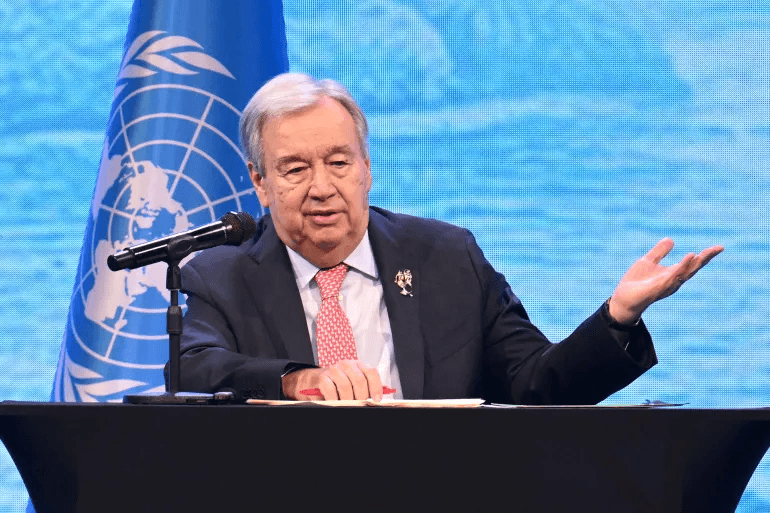
United Nations Secretary-General António Guterres has called on countries to develop a globally inclusive framework for managing artificial intelligence (AI) risks within the next year, warning that stronger international oversight is needed to ensure the technology remains under human control.
Speaking on Monday at the Bridgetown Special Summit on AI Safety in Barbados, Guterres urged UN member states to coordinate their efforts and establish shared principles for regulating the rapidly developing technology.
“I call for member states to coordinate efforts and to develop within the next year a globally inclusive and principles-based multilateral framework for AI risk management, backed by independent and credible oversight,” he said.
Guterres, whose term as UN Secretary-General is due to end in December, has increasingly highlighted the potential dangers of advanced AI, including the possibility of autonomous weapons systems commonly described as “killer robots”.
He argued that international institutions must adapt to the challenges of the modern world, noting that many existing global governance structures were established around the political realities of 1945.
“It’s clear that institutions need to be reformed in order to adapt themselves to the realities of today’s world,” he said, referring to the United Nations, international financial institutions and the global trade system.
Guterres also said he would advise his successor, who is expected to take office in the new year, that effective AI oversight would be essential for humanity to maintain control over its future.
Although international agreement on AI regulation remains difficult, particularly as the United States and China compete for technological leadership, Guterres suggested that countries could begin by agreeing on common safety standards, testing procedures and independent oversight requirements.
The debate over AI regulation has also divided major technology leaders. Some executives have called for a slowdown in AI development to address safety concerns, while others advocate continued rapid innovation.
In the United States, where AI development has advanced rapidly, immediate government intervention appears unlikely. In September, President Donald Trump hosted technology executives who agreed to follow a voluntary code of conduct on AI safety.
Guterres’ proposal adds to growing international calls for cooperation to ensure that the development of artificial intelligence is guided by safety, accountability and human interests.

Comments
No comments yet. Be the first to share a thought.